

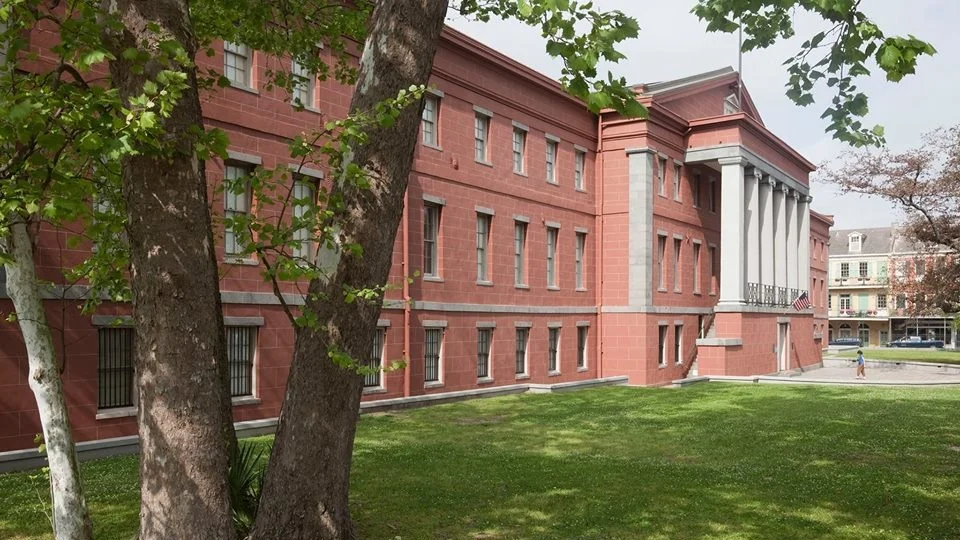
There is exactly one building in America that minted coins for the United States government, the Confederate States of America, and the short-lived Republic of Louisiana, and today it hosts free jazz concerts on its third floor most days of the week. The New Orleans Jazz Museum at the Old U.S. Mint sits at 400 Esplanade Avenue on the boundary between the French Quarter and Frenchmen Street, in a Greek Revival structure that architect William Strickland designed in 1835 and that has served as a federal mint, a Confederate barracks, a prison, and a Coast Guard facility before Louisiana took ownership in 1966.
The building’s second floor holds what the museum’s own curator has called the most important single object in jazz history: the cornet Louis Armstrong learned to play at the Colored Waif’s Home after his arrest for celebratory gunfire on New Year’s Eve 1912.
It sits in its own room at the end of the “It All Started in Jane Alley” exhibit, surrounded by instruments played by Kid Ory, Sidney Bechet, Johnny St. Cyr, and Dizzy Gillespie, alongside 12,000 photographs, thousands of recordings, and a piano from Fats Domino’s 9th Ward home that survived Katrina. The full collection runs to more than 25,000 items and is the world’s largest assemblage of jazz instruments owned and played by the music’s founding figures.
One floor above all of it, the $4 million Performance Center runs live music almost every day. The acoustics were engineered specifically for the space, and every performance is recorded and fed directly into the museum’s archival collection, meaning that what happens on the third floor tonight becomes part of the permanent historical record stored in the floors below it.
The National Park Service runs free 2 p.m. concerts on most open days through the New Orleans Jazz National Historical Park program, covering the full spectrum of traditional and contemporary jazz styles. Evening programming runs separately and includes ticketed concerts, lecture performances, oral history sessions, and curatorial panels.
The building’s ground floor covers the mint’s own history, including the O-mintmark coins struck here and the story of William Mumford, a Confederate sympathizer hanged on the premises in 1862 by Union General Benjamin Butler after tearing down a U.S. flag. The Louisiana Historical Center on the premises holds the French and Spanish Louisiana colonial archives and is open to researchers by appointment.
General admission runs $10 for adults, $8 for seniors, students, and military. The museum is open Tuesday through Sunday, 10 a.m. to 4:30 p.m., closed Mondays and state holidays. Check the current performance schedule at nolajazzmuseum.org before visiting, as the free 2 p.m. concerts are the most reliable entry point for first-time visitors.