

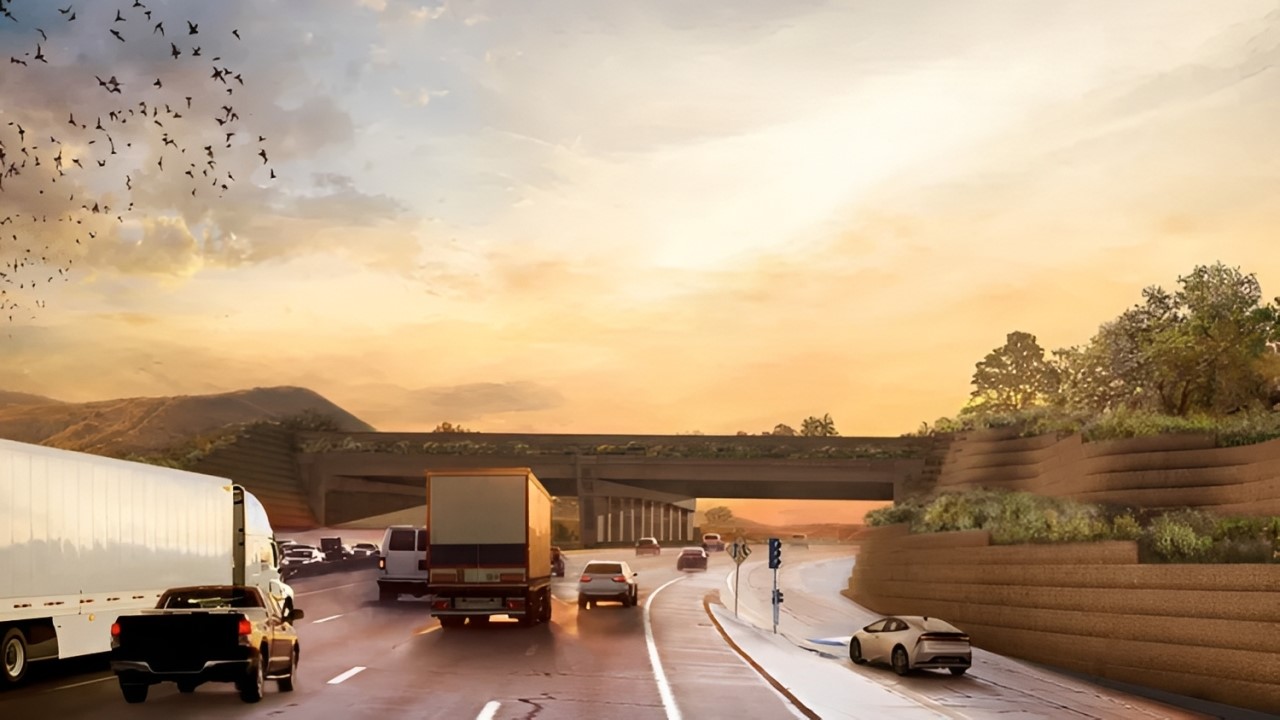
Wildlife-vehicle collisions plague Highway 101’s 10 lanes, but the Wallis Annenberg Wildlife Crossing eliminates this deadly barrier starting December 2, 2026. The world’s largest wildlife crossing now spans 320 by 175 feet over one of California’s busiest freeways, reconnecting fragmented habitats that have isolated mountain lions and other species for over three decades.
Engineering a Living Bridge
Since Earth Day 2022, crews have installed 82 large concrete beams, creating 55,925 square feet of vegetated overpass. The $114 million project sits 60% complete in Agoura Hills, northwest of Los Angeles, where the Santa Monica Mountains meet urban sprawl.
Mountain lions face local extinction without genetic diversity—this crossing provides their lifeline to populations in the Simi Hills and beyond. Workers are now spreading 3 million cubic feet of soil and planting 5,000 native plants grown from 1.1 million hyper-local seeds. Exclusionary fencing guides animals toward the crossing while berms block highway noise and light pollution.
Conservation Meets Education
The crossing targets species from bobcats to black bears, all struggling with habitat fragmentation in Southern California’s urban-wilderness interface.
A public viewing platform allows visitors to observe without disturbing wildlife movement, supporting California’s ambitious 30×30 conservation initiative. The site honors its location on Chumash homelands while serving as a living laboratory for similar projects nationwide.
Governor Newsom’s Earth Day announcement marked a milestone for this first California highway bridge designed exclusively for wildlife passage—visible proof that conservation and infrastructure can coexist on one of America’s most congested corridors.