

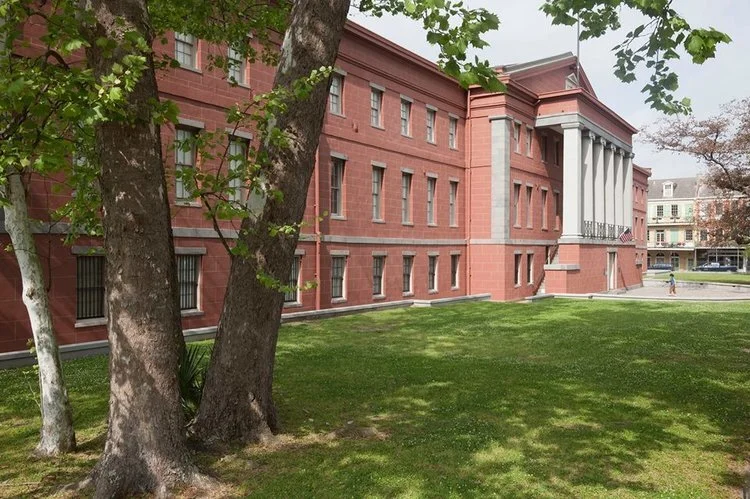
The New Orleans Jazz Museum occupies the only building in America that ever struck coins for both the United States and the Confederacy.
The Old U.S. Mint went up in the 1830s on a design by Philadelphia architect William Strickland, whose other work includes the Second Bank of the United States and the Tennessee State Capitol. The facility produced currency from 1839 until 1909. The coin room survives as an exhibit in its own right, walking visitors through how the money got made. Confederate forces seized the building early in the Civil War, and a man named William Mumford was hanged on the grounds in 1862 for tearing down a United States flag.
Jazz moved in later, and the collection now runs to roughly 50,000 pieces. Highlights include Louis Armstrong’s first cornet, Sidney Bechet’s soprano saxophone, and Edward “Kid” Ory’s trombone. Curators rotate material through the galleries rather than parking it all on permanent display, so repeat visits turn up different objects.
Several exhibitions are up right now. It All Started in Jane Alley opened in 2024 as a permanent look at Armstrong’s childhood, tracing the influence of his mother Mayann, the Karnofsky family who employed him, his teacher Peter Davis, and his mentor Joe “King” Oliver. Congo Square to the World makes the museum’s case for why jazz emerged here specifically, running from Congo Square through Storyville to the 1917 recording of “Livery Stable Blues.” Drumsville traces the drum kit’s invention in this city, with gear from Baby Dodds, Earl Palmer, Idris Muhammad, and Zigaboo Modeliste alongside loans from living masters like Herlin Riley and Stanton Moore.
Newer shows push in other directions. The First Piano Professors and Lost Music of Early New Orleans draws on three decades of collecting by pianist John Davis, pairing rare first-edition sheet music with newly commissioned recordings of pieces that had gone unrecorded since the 1800s. The design firm 2×4 built an immersive sound environment around it. The King at 100 marks the centennial of Clifton Chenier, the zydeco pioneer who invented the shoulder-worn frottoir with his brother Cleveland. Less is More collects photography by Steve Rapport, who came to town for four days in 2022 and moved here seven weeks later. Face Value puts new coins minted by the artist duo Generic Art Solutions beside historic ones in the coin room, along with a working jukebox loaded with songs about money.
Live music is the other half of the operation. A performance hall on the third floor, built for about $4 million, has acoustics and recording equipment good enough that shows get archived. Music happens almost every day the museum is open, with free afternoon concerts and ticketed evening shows. Researchers can book time in the reading room to work with the archival holdings by appointment.
Practical details need a phone call. The museum’s own site lists hours as Sunday through Saturday, 9 a.m. to 4 p.m., though the Louisiana State Museum system and several listings show a Monday closure. Call (504) 568-6993 before planning a Monday visit.
Admission runs $11 for adults and $9 for students, seniors, and active military. Children 6 and under enter free, and school groups with reservations get in free as well. Groups of 15 or more receive 20 percent off, as does anyone buying tickets to two or more Louisiana state museums. AAA members save 10 percent. Tickets are available online through the state museum system.
The building is ADA compliant with elevators to every floor. Staff recommend the Barracks Street entrances, and construction has put a ramp at the Esplanade Avenue door.
The address is 400 Esplanade Avenue, a short walk from Frenchmen Street, so plan the visit around an afternoon set and stay for the neighborhood.