

The reading room at the Williams Research Center has 24-foot ceilings because it used to be a courtroom.
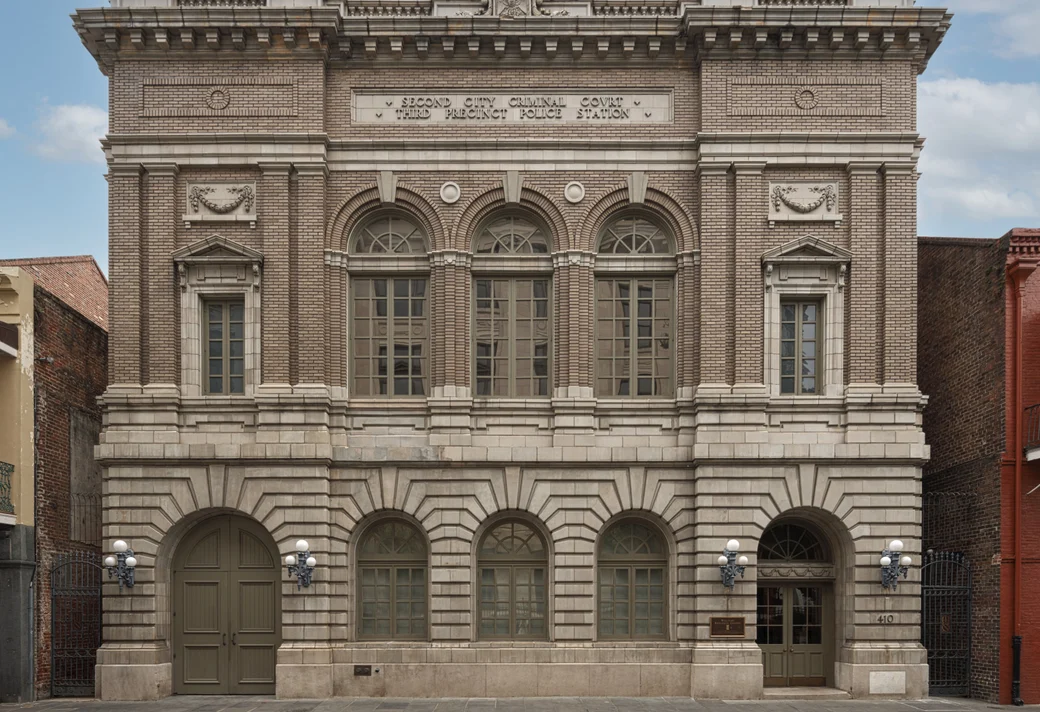
City architect Edgar A. Christy designed the building at 410 Chartres Street in 1915, during the administration of Mayor Martin Behrman. Christy held the city architect post from 1904 to 1923 and oversaw school construction for Orleans Parish for nearly thirty years after that. He gave this one a Beaux Arts facade with three large round-arched windows on each floor, a terra-cotta first level set into exaggerated stone joints, and a brick second story finished with decorative garlands and a roofline balustrade. Builder James A. Petty put it up.
The building worked as the Second City Criminal Court and the Third District Police Station. Over the decades it also housed a juvenile court, a night court, and a military court during World War II. There were jail cells inside. The land underneath had belonged during the colonial period to the Marigny de Mandeville family, one of the oldest names in the city.
Louisiana bought the property in 1957, and it sat vacant and deteriorating for years. The Historic New Orleans Collection picked it up at auction in 1993 and hired Jahncke Architects for the restoration. The courtroom on the second floor became the public reading room, and the rest of the floor space was rebuilt as secure climate-controlled storage. The center opened on January 20, 1996 with a day of lectures and a black-tie gala that night.
An addition came later and has its own story. Completed in June 2007, it was the first new construction finished in the French Quarter after Hurricane Katrina. Architect Davis Jahncke based the design on a drawing pulled from the New Orleans Notarial Archives showing a blush-colored hotel that stood on that exact lot in the 1850s. He worked in 19th-century building techniques including hand-hammered hardware, a false carriageway, and false chimneys. The addition holds three floors of archival storage plus the Boyd Cruise Room, named for the Collection’s first director, which hosts lectures and exhibitions.
What sits in storage is the reason to come. The holdings run to tens of thousands of library items and hundreds of thousands of photographs, prints, drawings, and paintings, along with manuscripts available in the original and on microform and a range of three-dimensional objects. The Vieux Carré Survey is the standout for anyone curious about a specific building. Started in 1960 to support preservation work, it compiles detailed property records for every building and lot in the French Quarter from the French colonial period forward.
Literary researchers come for Tennessee Williams. HNOC is one of four main repositories of the playwright’s papers and publishes an annual scholarly journal and hosts a conference devoted to his work. Reference staff also help with genealogy, land records, and newspaper archives covering colonial Louisiana and the wider Gulf South.
The process is simple and worth understanding before showing up. This is a reading room rather than a gallery, so nothing sits out on open shelves. A visit starts with an interview with reading room staff about what you are looking for, followed by a search through the catalogs. Staff then retrieve the material. Anyone can search the online catalog from home first, which makes the conversation faster.
Admission is free and the center is open to the public. Hours run Tuesday through Saturday, 9:30 a.m. to 4:30 p.m., with Sunday and Monday closed. Appointments are recommended and not required. Reference associates will correspond about a research topic ahead of time at reference@hnoc.org or (504) 598-7171.
Bring a question, even a small one, and see how far the staff can run with it.