

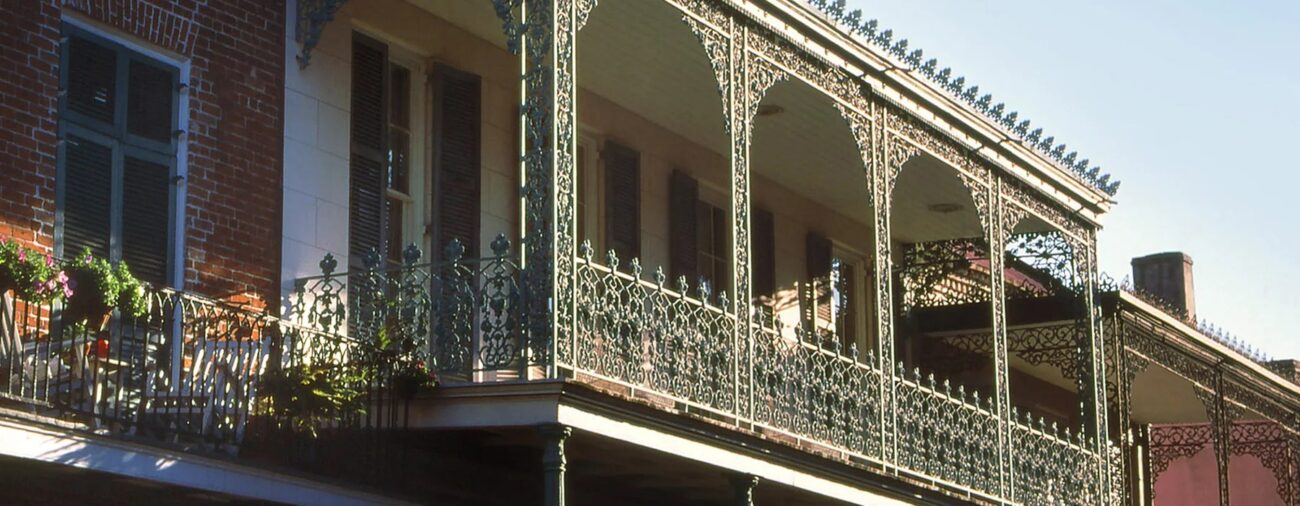
Gallier House sits at 1132 Royal Street in the French Quarter, and the man who built it designed it for himself.
James Gallier Jr. was one of the most sought-after architects in mid-19th-century New Orleans, and he broke ground on his own family home in 1857. The house was finished by 1860. What he built functions now as a record of how a wealthy urban household actually operated, down to the plumbing. The place had indoor plumbing with hot and cold running water at a time when most American homes had neither. A double skylight pulls daylight deep into the interior. The ventilation system was engineered to move air through a house in a city where summer heat could turn deadly.
The furnishings are the other draw. Curators used the Galliers’ original household inventory as the guide when outfitting the rooms, so the period decorative arts on display reflect what the family actually owned rather than a general impression of Victorian taste. Docents walk visitors through the parlors, bedrooms, and service spaces on every tour.
Tours also address who did the work. The comfort the Galliers enjoyed depended on enslaved people, and later on paid domestic servants, and the interpretation covers their labor and their lives alongside the family’s. That approach carries across to the organization’s other property.
Hermann-Grima House at 820 St. Louis Street predates Gallier House by nearly thirty years. Built in 1831 behind a Federal-style façade, it holds an original open-hearth kitchen that still operates, urban slave quarters, and a large courtyard. Its standard tour focuses on urban enslavement in New Orleans, examining how the experience differed from enslavement on rural plantations. Condé Nast Traveler named it one of the best tours in the city and the only museum tour on that list.
Seasonal programming shifts through the year. Summer brings a Summer Dress tour at Gallier House, built around the housekeeping practice of converting a home’s interior for the hot months. Fall brings a tour on Creole death and mourning rituals. Both houses get dressed for the holidays, with Hermann-Grima set for 19th-century Creole New Year’s celebrations and Gallier House for a Creole Christmas. The organization also runs open-hearth cooking demonstrations and maintains a public database of enslaved individuals connected to the properties.
The Woman’s Exchange manages both houses. That group founded the Exchange Shop next door at 818 St. Louis Street in 1881, making it one of the oldest women-led nonprofits in the South. The shop occupies a 19th-century carriage house.
Practical details are straightforward. Both houses open six days a week and close Tuesdays. Hermann-Grima runs 10 a.m. to 4 p.m. with tours at 10, 11, 1, 2, and 3, skipping noon. Gallier House runs 10:30 a.m. to 4:30 p.m. with tours at 10:30, 11:30, 1:30, 2:30, and 3:30, skipping 12:30. Every visit is by guided tour with a docent, and reservations are encouraged.
Admission runs $20 per adult for one house and $34 for both. Military, seniors 65 and up, students over 18, and children 8 to 18 pay $17 and $29. Children under 8 get in free. Neither house has parking, and street parking in the Quarter is limited and heavily regulated, so plan on a paid lot. Cameras are fine without flash or tripod, and large bags get checked at the shop.
Check the organization’s social media before heading over, since last-minute closures get posted there first.