


Cambridge topped Time Out’s 2026 ranking, according to Time Out; Cambridge City Council separately reports that one in three residents cycles to work.
Planners love drawing bike lanes on maps. Residents know which ones you’d actually use. That gap is exactly what Time Out’s 2026 cycling ranking tries to close — surveying more than 24,000 urbanites across the globe and limiting results to one city per country, so the list doesn’t collapse into a Scandinavian podium sweep. What emerges is a genuinely global read on where cycling is easiest, according to the people who do it every day.
Where Flat Beats Fancy
Cambridge tops the list at 83.2%, but Montreal’s second-place finish — achieved despite cold winters — makes the stronger argument for what dedicated infrastructure can accomplish.
Cambridge wins on geography: compact, flat, with designated cycle streets and a multistory cycle park at the railway station. Cambridge City Council reports that one in three residents cycles to work, suggesting that cycling here functions as straightforward everyday transport rather than a weekend pursuit.
Montreal’s 82.5% score is the more surprising result. Snow and a reputation for brutal winters might reasonably complicate cycling’s appeal. Instead, the city has built 1,083 kilometres of bike network, 251 kilometres of it physically protected, and its official route map identifies year-round paths maintained through winter conditions. BIXI, the city’s bike-share system, runs nearly 934 stations and close to 11,000 bicycles — more than 2,600 of them electric, according to the International Cycling Union. Thoughtful infrastructure, the ranking suggests, can outweigh imperfect geography.
Cities Worth the Saddle Time
The middle of the table rewards visitors who know which routes to choose.
- Copenhagen (79.2%) — decades of planning have produced textured road surfaces, narrow lanes, and low-speed zones designed to calm traffic
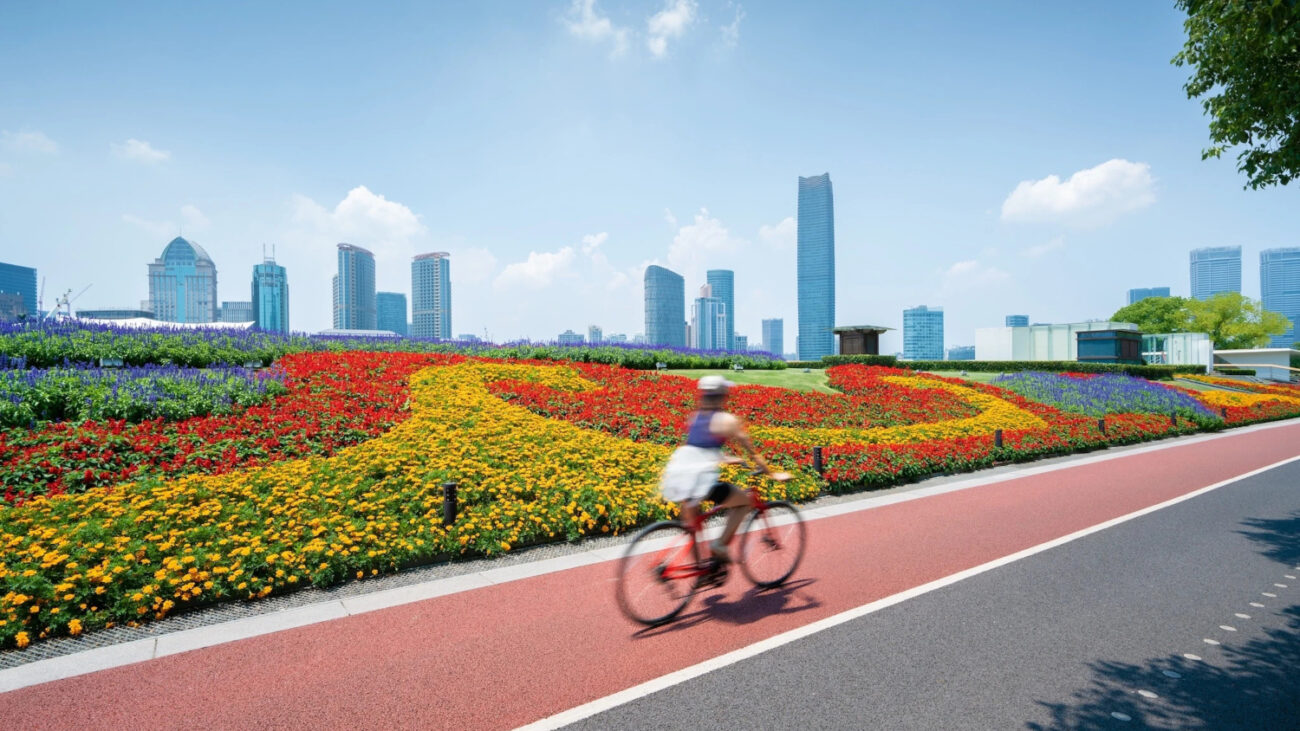
- Shanghai (78%) — features the 24-kilometre car-free Pudong Riverside Greenway — genuinely peaceful riding — though the surrounding urban roads carry considerably more traffic and demand more caution
- Vienna (77.7%) — roughly 1,800 kilometres of cycle lanes and the WienMobil Rad bike-share scheme for shorter stays
- Warsaw (76.6%) — around 500 kilometres of paths, including a Vistula riverside route that passes the Copernicus Science Centre and Multimedia Fountain Park
- Seville (72.3%) — flat terrain, approximately 180 kilometres of lanes, cyclist-specific traffic lights, and SEVici bike-share connecting Plaza de España and the Real Alcázar
Beyond the Top Five
The full ranking spans five continents and includes a few cities that challenge assumptions about where cycling belongs.
- Marrakech (75%) — cycling inside the medina is genuinely difficult, but the wider streets of Gueliz are more manageable, and the surrounding region opens up longer rides toward the Atlas Mountains
- Taipei (74.5%) — offers riverside routes along the Keelung and Tamsui rivers
- Orlando (68.7%) — the sole entry from the United States
- Brasília (64.4%) — represents South America
The one-city-per-country rule is what keeps this list genuinely diverse rather than a ranking dominated by a handful of cycling-forward nations.
The cities that score highest share a common thread: cycling infrastructure is woven into how residents actually move, not bolted on as a recreational afterthought. For travelers deciding where to go next, that distinction is worth paying attention to.