

New Orleans built its wealth on sugar, cotton, coffee, and the shipping trade that moved all of it through the port. The warehouses that stored that commerce are still standing in the Warehouse District and along the riverfront, and some of the better hotels in the city have moved into them without apologizing for the raw materials they contain. Exposed brick, heavy timber, cast iron, and high ceilings are the design language here, not Victorian lace.
ONE11 Hotel

The seven-story white brick building at 111 Iberville Street was constructed in 1884 by the American Sugar Refining Company, one of only three surviving structures from what was once a dense Sugar District between Bienville and Conti Streets that stretched along the Mississippi riverfront.
Most of the others were demolished by the 1940s. This one sat vacant for decades, was briefly converted to office space in 1971, and then sat mostly empty again until developer Wayne Ducote, who bought it at auction in 1993, spent nearly 30 years fighting the city’s 1969 moratorium prohibiting new hotels in the French Quarter to get it approved.
ONE11 Hotel opened in January 2021 as the first new hotel allowed into the Vieux Carré in over 50 years, with 83 rooms across eight floors. The design team from Dash Design worked specifically to expose every original element they could: wood columns, steel bracers, metal pipes, and conveyor belt hardware embedded in the exterior walls, and exposed brick throughout.
The caramel-and-white color palette is a direct reference to the sugar processing history. The rooftop deck and penthouse suites, the only new construction added to the building, offer sweeping views of the French Quarter and the river. The Batture Bistro + Bar on the ground floor serves breakfast, brunch, and small plates through the evening. ONE11 is at 111 Iberville Street.
The Old No. 77 Hotel & Chandlery
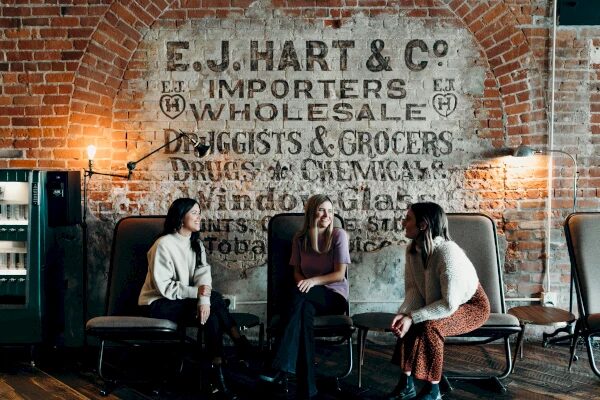
The building at what was once 77 Tchoupitoulas Street has been in continuous commerce since 1854, when it served as a tobacco and coffee warehouse for the Port of New Orleans. It was later purchased by E.J. Hart & Company and converted into a chandlery, the name for a general store supplying the shipping industry with canvas, rope, paper, and patent medicines, which is where the hotel’s name comes from. The address changed to 535 Tchoupitoulas when New Orleans reorganized its street numbering system, but locals kept calling it the old No. 77 for decades.
The Old No. 77 Hotel & Chandlery has been a hotel since 1997, when the building was first converted from warehouse use, and was renovated and rebranded in 2015 to its current form. The 167-room property was assembled from three connected 19th-century warehouse structures, and rooms vary between exposed brick with ceiling beams and more standard configurations depending on where they sit in the original floor plan.
The lobby runs through hardwood floors and art commissioned from students at NOCCA, the New Orleans Center for Creative Arts, with a rotating gallery keeping the collection current. The on-site restaurant is Compère Lapin, the flagship of James Beard-winning chef Nina Compton, covered in detail in the dining section of this guide. Dogs are welcome, with a full pet kit provided at check-in.
Renaissance New Orleans Arts Warehouse District Hotel
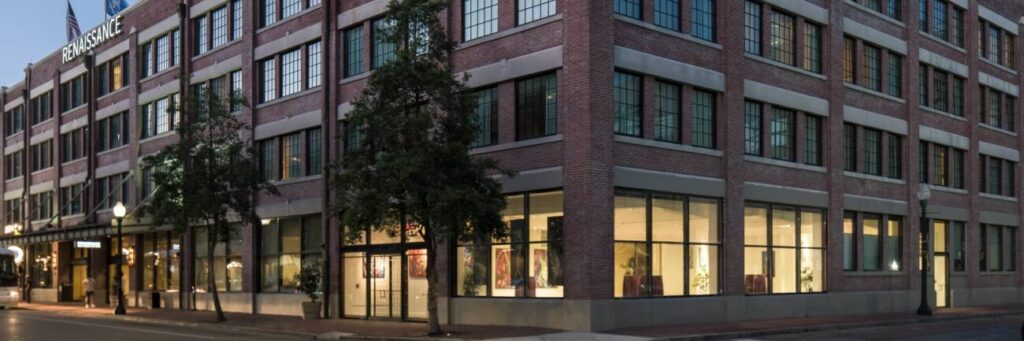
The circa-1910 warehouse on Tchoupitoulas Street in the Arts District was converted into a hotel and has been running as a full-service property for over two decades. The building’s scale translates well: lobby ceilings run high, the common areas feel large and airy, and multicolored glass chandeliers hang above the reception desk in a nod to the glass studios and art galleries surrounding the property. An indoor sculpture garden on the second floor is designed with a carved path and an atrium ceiling that pulls natural light down into the building’s center. A separate gallery space hosts rotating exhibitions throughout the year. The rooftop pool and terrace overlook the Warehouse District skyline.
The 219 rooms are modern and design-forward, with art on every wall pulling from the local collection. The on-site restaurants include Legacy Kitchen and a cafe-counter option for grab-and-go.
The location between the French Quarter and the Convention Center is useful: three blocks to the convention center, walking distance to the WWII Museum, Ogden Museum, and the main gallery strip on Julia Street. The Renaissance is at 700 Tchoupitoulas Street. Book through Marriott Bonvoy.