

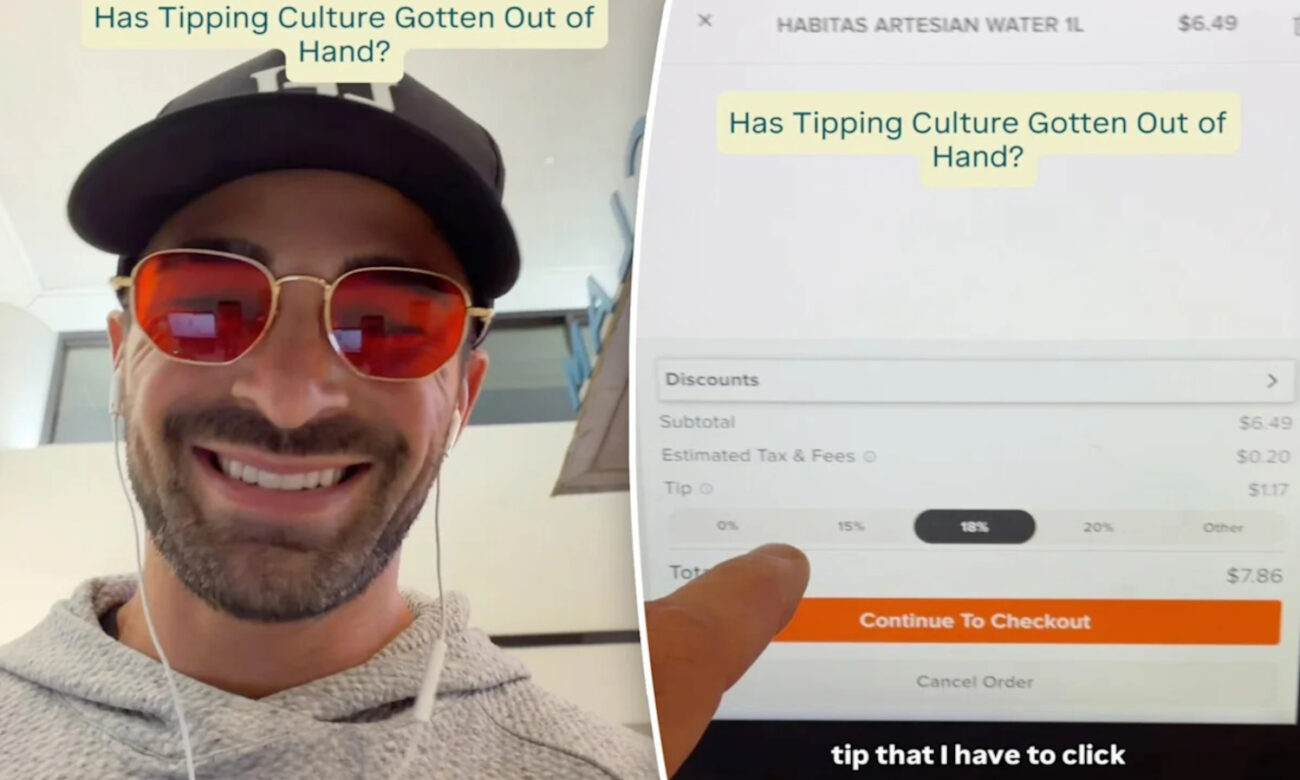
Dr. Clay Moss documented exactly this at a grab-and-go store reportedly near Happy Clam at Newark Airport, posting a TikTok showing a self-checkout kiosk requesting gratuity options of 10%, 15%, or 18% after he scanned a $6.49 bottle of water. The video struck a nerve with anyone who has quietly accepted a tip screen without asking why. Because the question Moss asked out loud — “Who am I tipping here?” — is one most travelers swallow in silence, a symptom of a broader tipping culture that has quietly expanded into every corner of commerce.
When the Machine Asks for a Tip
A $6.49 water bottle, approximately 20 cents in taxes and fees, and a $1.17 suggested tip at 18% — with no employee visible during the transaction.
The kiosk displayed three percentage options alongside a “no tip” selection. That last part matters: the gratuity was optional. But Moss’s real critique wasn’t about the dollar amount. It was about design. Presenting 18% as a prominent option may create social pressure even when no direct service has been rendered — a case of responding to software rather than to a person.
Here’s what the screen showed:
- Tip options of 10%, 15%, and 18% at a self-checkout terminal
- A suggested $1.17 gratuity on a $6.49 item at the 18% level
- No employee visible during the transaction
- A “no tip” or zero-percent selection available on screen
“Who am I tipping here?” — Dr. Clay Moss
The transparency problem runs deeper than one kiosk. When third-party payment processors handle transactions, it becomes genuinely unclear whether tips reach store workers, flow into a shared employee pool, or go elsewhere entirely. Available reporting does not establish who received the money from this specific terminal. That uncertainty isn’t a minor footnote — it’s the whole argument. Think of it as the shrinkflation of service: the gesture of tipping remains while the context quietly disappears — much as outlets that routinely overcharge rely on consumer inattention to obscure what is actually happening.
Online reaction was sharp. Commenters argued that self-checkout customers should receive a discount, not a tip prompt, since they’re doing the scanning themselves. These are social media opinions, not verified consumer research — but they reflect a frustration that businesses increasingly ignore at their peril.
So What Do You Actually Do?
Moss’s advice is blunt and practical — a useful reset before the next time a screen puts the question to you.
- Decline when no service occurred.
- Ask a visible employee where gratuities actually go.
- Consider carrying cash to sidestep confusing digital prompts entirely.
None of that is radical. It’s just informed.
The real issue isn’t one $1.17 tip. It’s that a screen can make optional feel obligatory without explaining where the money goes or who benefits. Until businesses clearly disclose how gratuities are distributed — much like the backlash triggered by any hidden fee — the most straightforward move may be the one sitting quietly beside the percentages: the most honest move is the one the screen tries hardest to hide.