

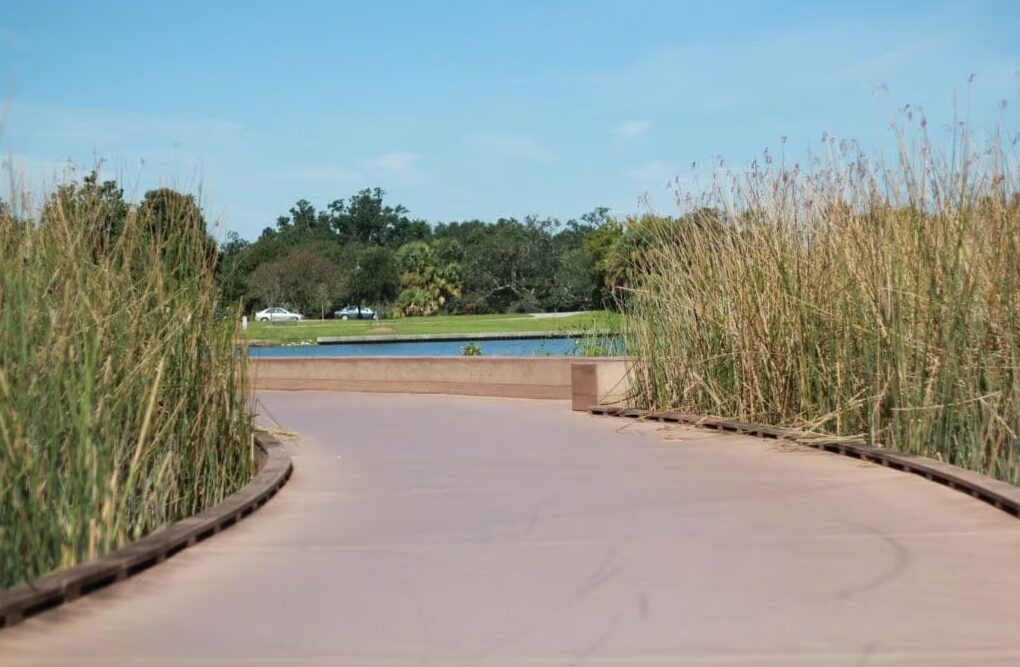
Ask most visitors what’s growing along the northern edge of Big Lake in City Park and you’ll get a blank look — the Zemurray path, the art installations, and the boat rentals tend to absorb all the attention. The Big Lake Native Plant Trail is a 0.12-mile gravel path running quietly along that northern bank, maintained by volunteers from the Native Plant Initiative of Greater New Orleans in partnership with City Park’s grounds team, and it contains something genuinely worth slowing down for.
The beds along the trail are planted specifically with species indigenous to southeast Louisiana, representing the floral communities that covered this coastal delta landscape before development replaced them with lawn grass and ornamentals.
Prairie Verbena, Blazing Star, Blue Wood Sedge, White Prairie Clover, Elliott’s Lovegrass, and Drummond Phlox all appear along the path, alongside Swamp Rose Mallow, Louisiana Iris, and Texas Coneflower. The plantings follow a matrix design concept: dense masses of native grasses and perennials selected to attract birds, butterflies, and pollinators. The result is impressive: the trail looks different in every season and rewards more than one visit across the year.
The Native Plant Initiative of Greater New Orleans drives the ecological thinking behind the beds. The organization runs a weekly volunteer restoration project along the trail focused on weeding, mulching, invasive species removal, and maintaining the garden beds, and it hosts periodic plant giveaways at the trailhead amphitheater seating area near the lake. At those events, participants can take home plugs of the same species growing in the beds, which is one of the more practical educational outcomes any public trail offers.
The trail itself is short enough to walk in ten minutes, but the density of labeled plantings makes it function more like an outdoor reference collection than a walking path. Interpretive signage identifies the species and their ecological roles, connecting what’s growing in the bed to the broader coastal habitat that once characterized this part of Louisiana. For anyone planning to garden with native species in the New Orleans area, the trail is the most accessible working example of what that looks like at scale.
The trail sits near the boat and bike rental area on Friedrichs Avenue on the north side of Big Lake. It connects to the Zemurray Multi-Use Path, which circles the full lake perimeter and links back to the Festival Grounds path and the broader City Park trail network.