

Guests checking into the Ritz-Carlton ride an elevator past two floors before they reach the front desk, because the building was designed to sell dresses and not rooms.
The hotel occupies the Maison Blanche building at 921 Canal Street, a Beaux Arts landmark faced in glazed white terracotta that went up between 1906 and 1909. S.J. Shwartz built it after his department store outgrew its previous home, tearing down the Mercier building to make room. Maison Blanche called itself the Greatest Store South and spent most of a century proving the point on Canal Street. The hotel says the building also housed local businesses and WSMB Radio, which it describes as the city’s first radio station.
The store’s decline tracked the decline of downtown shopping. Maison Blanche closed the Canal Street location in the early 1980s, reopened it in 1984, and lost it for good when Dillard’s acquired the chain in 1997 and shut the downtown store.
The conversion that followed cost a reported $250 million. The Ritz-Carlton opened in 2000, absorbing the neighboring Kress five-and-dime building as well. The Iberville Street side of the complex became a separate Marriott property. A second renovation finished in 2006, with further refurbishment in 2019.
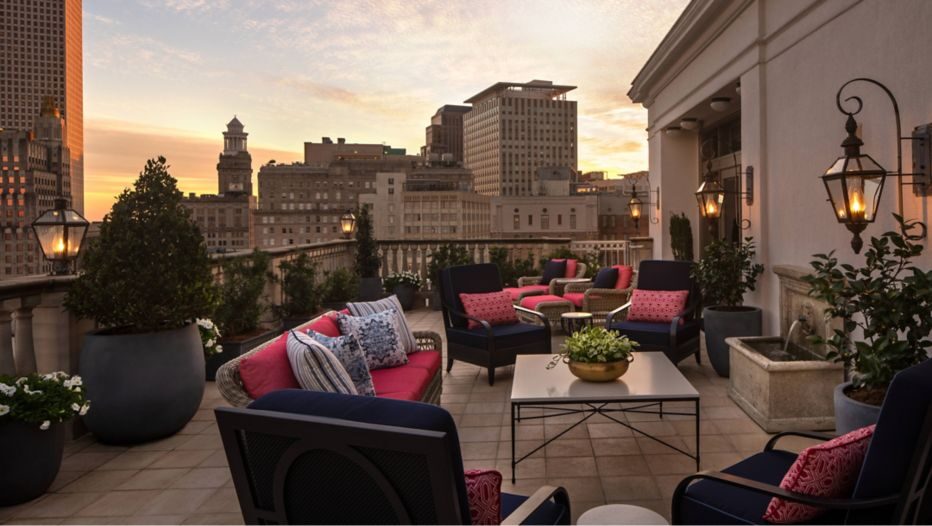
The building’s bones still dictate the floor plan. The lobby sits on the third floor with an open-air courtyard off it, a layout that exists nowhere else in the Ritz-Carlton portfolio and traces directly to the department store that came before. More than 500 rooms and suites fill the floors above, decorated to echo Garden District mansions with jewel tones, neoclassical furnishings, and commissioned artwork tied to local heritage.
The spa is the property’s headline amenity. At 25,000 square feet it is the largest in the city, with 22 treatment rooms, more than 100 treatments, a café, and a boutique. Chandeliers, fountains, and lavender mint set the tone, and treatments carry names like the Voodoo Ritual and Southern Ceremony. An indoor resistance pool, steam room, sauna, and a 24-hour fitness center with Peloton bikes round it out.
Two rooms handle the eating and drinking, both on the third floor. M Bistro serves farm-to-table Louisiana cooking with seasonal meats, seafood, and regional produce, under a large skylight, and puts out a breakfast buffet Saturday and Sunday from 7 a.m. to noon. Three velvet-draped semi-private tables there are known as the Cheater’s Booths.
The Davenport Lounge sits next door and carries the hotel’s musical weight. Trumpeter Jeremy Davenport, who studied under Ellis Marsalis and toured six years with Harry Connick Jr.’s big band, plays Wednesday and Thursday from 5:30 to 9:30 p.m. and Friday and Saturday from 8 p.m. to midnight. Afternoon tea runs Saturday and Sunday at 11 a.m. and 2:30 p.m. with live harp.
Parking costs add up fast, with posted nightly rates reaching $77 for electric vehicles and $150 for Sprinter vans. Lounge guests get a reduced four-hour rate.
A century ago, shoppers rode those same elevators up to the millinery department. The building kept the layout and swapped the inventory.