

The best music in New Orleans has never been on Bourbon Street. It’s on Oak Street, on Napoleon Avenue, on Frenchmen Street, in the neighborhoods where the musicians actually live. These four venues are the reason serious music travelers leave the Quarter entirely.
The Maple Leaf Bar

The bar that opened on February 24, 1974, was originally called the Maple Leaf Rag Time Bar and Chess Club, after Scott Joplin’s ragtime composition, and was intended as a quiet intellectual gathering space where people could play chess, read, drink, and occasionally hear some local jazz. That vision lasted about two years. By 1976, the music had taken over completely, and the Leaf has had live performances seven nights a week ever since, making it one of the longest continuously operating live music venues in New Orleans.
James Booker played every Monday evening there from 1978 until his death in 1983. The Rebirth Brass Band has held the Tuesday night slot for so long that it has become a standing institution, the kind of weekly gig that regulars plan their week around. Grammy Lifetime Achievement winner George Porter Jr. of the Meters holds Monday nights now. The physical space is what you’d expect: pressed-tin ceilings, a narrow stage with a bare bulb or two, a packed dance floor, a back courtyard, no pretension whatsoever. The Sunday afternoon poetry series in the courtyard, running continuously since the late 1970s, is the longest-running poetry reading in North America. The Krewe of Oak begins and ends its Mardi Gras parade here.
The Maple Leaf Bar is at 8316 Oak Street in Carrollton, at the bend in the river where the streetcar turns. Open nightly. No dress code. No attitude.
Tipitina’s

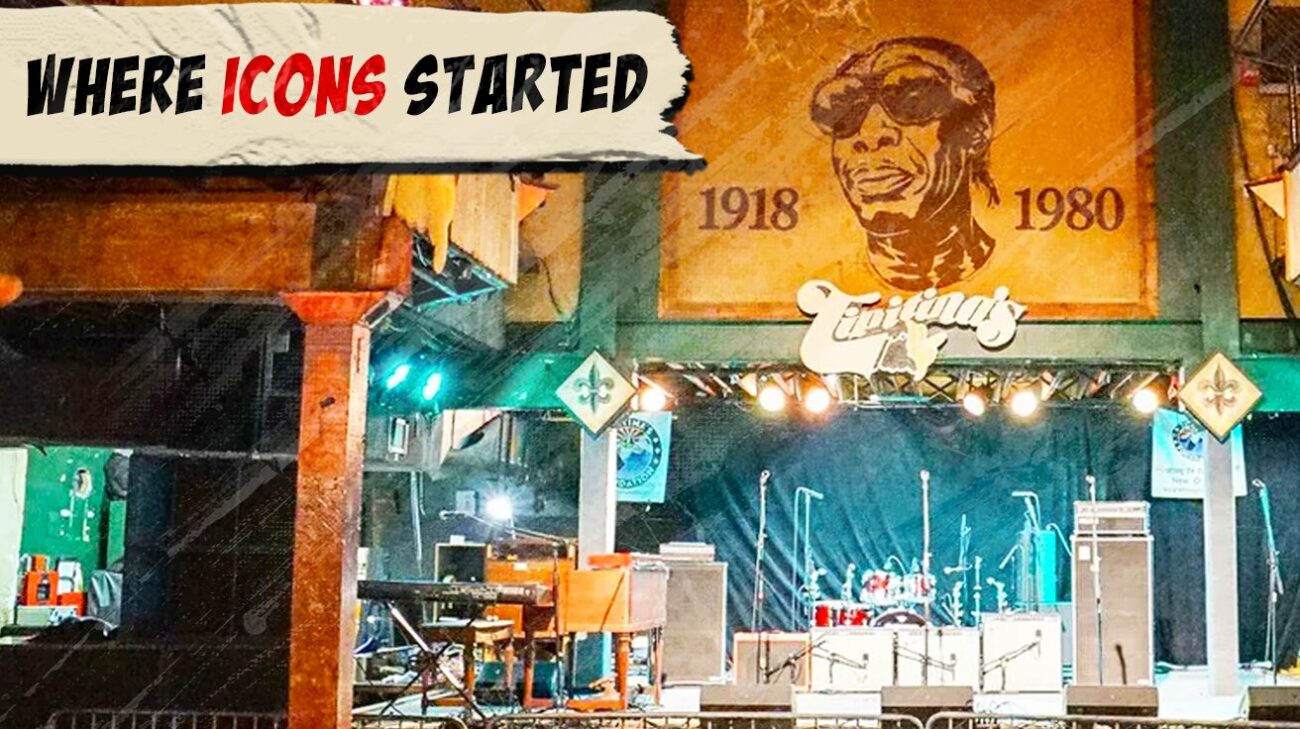
Fourteen local music fans pooled roughly $14,000 in late 1976 to take over a former gambling house, gymnasium, and brothel at the corner of Napoleon Avenue and Tchoupitoulas Street. Their specific goal was to give Professor Longhair, the R&B piano genius known as Fess, a room to play in regularly. His career had largely stalled, his influence on New Orleans music was enormous and poorly compensated, and these people wanted to fix that. They named the club after his 1953 song “Tipitina” and opened on January 14, 1977. Longhair performed there until his death in 1980. His bust stands just inside the entrance. His face watches over the stage from a mural above it.
The room they built has held everything since: the Neville Brothers, Dr. John, the Meters, Allen Toussaint, the Radiators, Galactic, Trombone Shorty, and thousands of touring acts who came specifically to play this stage. WWOZ began broadcasting in 1980 from apartments above the club, sometimes dropping a microphone through a hole in the floor to carry live shows.
Galactic, the New Orleans jam-funk outfit, purchased Tipitina’s from its previous owners in December 2018 and has run it since with a stated mission of preserving the room without freezing it. The annual Fess Jazztival during Jazz Fest weekend is the high point of the calendar. Tipitina’s is at 501 Napoleon Avenue.
Snug Harbor Jazz Bistro

The New York Times called it the classiest jazz club in New Orleans. Rolling Stone called it a musical landmark. The room itself seats 85 people, including the upstairs balcony, which is about the right size for a jazz ensemble when you want everyone in the room to actually hear what’s happening. That’s the point of Snug Harbor: it was built as a listening room, not a bar that happens to have music, and that distinction has held since Glenn Menish opened it in 1983 in a renovated 1800s storefront on Frenchmen Street.
The late Ellis Marsalis Jr., patriarch of the most prominent jazz family in New Orleans, held a regular Friday night residency here for decades. His sons Delfeayo and Jason have continued that connection, with Delfeayo leading the Uptown Jazz Orchestra on Wednesdays and Jason performing regularly on the schedule. Charmaine Neville, daughter of Art Neville, has been a Monday fixture.
The format is ticketed shows, seated, with two performances most nights at 7:30 and 9:30 p.m. There is also a full restaurant and a bar where you can watch on a monitor if the music room is sold out. Book tickets in advance for anything involving the Marsalis family.
Snug Harbor Jazz Bistro is at 626 Frenchmen Street. Call (504) 949-0696.
The Spotted Cat Music Club

The building at 623 Frenchmen Street began as a restaurant called Frenchmen Oyster House in the 1970s. The Spotted Cat opened there in December 2000 as a club for local musicians, with no cover charge and no pretension, and it has been one of the most reliably packed rooms on the street ever since. The stage sits against the front window, which means pedestrians on Frenchmen Street press their faces to the glass to see who’s playing, which is its own kind of entertainment.
The format is straightforward: rotating local bands play jazz, swing, blues, funk, klezmer, and whatever else fits the room, from late afternoon until past midnight, seven days a week.
The dancers arrive on Friday and Saturday nights for swing sets. The musicians rotate constantly, which means the quality of any given night depends on who’s on the schedule, but the best nights at the Cat are as good as anything you’ll hear on Frenchmen. There is no kitchen, barely a cocktail program, and limited seating, all of which keep the focus exactly where it belongs.
The Spotted Cat is at 623 Frenchmen Street. A small cover charge now applies for most shows; check the website for the current schedule. The street outside is free, and on a warm night, standing at the window is its own experience.