

The war was already over. Nobody knew it yet.
On January 8, 1815, the Treaty of Ghent was signed two weeks earlier in Belgium, formally ending the War of 1812. But news traveled by ship, and neither side had received word. So the British came anyway, 8,000 battle-hardened redcoats funneling through the fog toward a defensive line dug along Rodriguez Canal on the Chalmette Plantation, five miles south of New Orleans. What happened in the next 37 minutes changed American history regardless of the treaty. You can stand on that ground today for free.
Chalmette Battlefield is part of Jean Lafitte National Historical Park and Preserve, about six miles downriver from the French Quarter along the Mississippi. The site is quiet now, flat and open, with a view of the river and a 100-foot obelisk rising above the tree line.
But the story embedded in this ground is anything but quiet. General Andrew Jackson had assembled one of the most unusual fighting forces in American military history to defend the city: Tennessee and Kentucky frontiersmen, Louisiana militia, Free Men of Color, Choctaw warriors, New Orleans businessmen, and the Baratarian privateers of Jean Lafitte, whose gunpowder and expert artillery crews Jackson desperately needed. Many Americans at the time questioned the wisdom of arming free Black men and pardoning pirates. Jackson did it anyway.
The British sent their men across an open cane field into withering cannon and rifle fire. When the fog lifted that morning, the redcoats were fully exposed. In 37 minutes, the British suffered over 2,000 casualties. The Americans lost fewer than 70. British commander Major General Edward Pakenham, the brother-in-law of the Duke of Wellington, was killed on the field.
The reconstructed American rampart still stands on the battlefield, with reproduction artillery pieces positioned in the embrasures where Jackson’s gunners held the line. The Rodriguez Canal, greatly reduced in size but still visible, remains the only human-made War of 1812 artifact still on site.
The battlefield holds more than one chapter. After the Civil War, a self-contained African American community called Fazendeville grew up on the grounds and thrived there for nearly a century before the National Park Service purchased the land in contentious negotiations. Remnants of that community, including the Fazendeville Iris, still bloom here each spring. The 1832 Malus-Beauregard House, a Greek Revival structure, stands near the river levee and is currently undergoing restoration. Behind it, the levee offers a sweeping view of the Mississippi that alone is worth the drive.
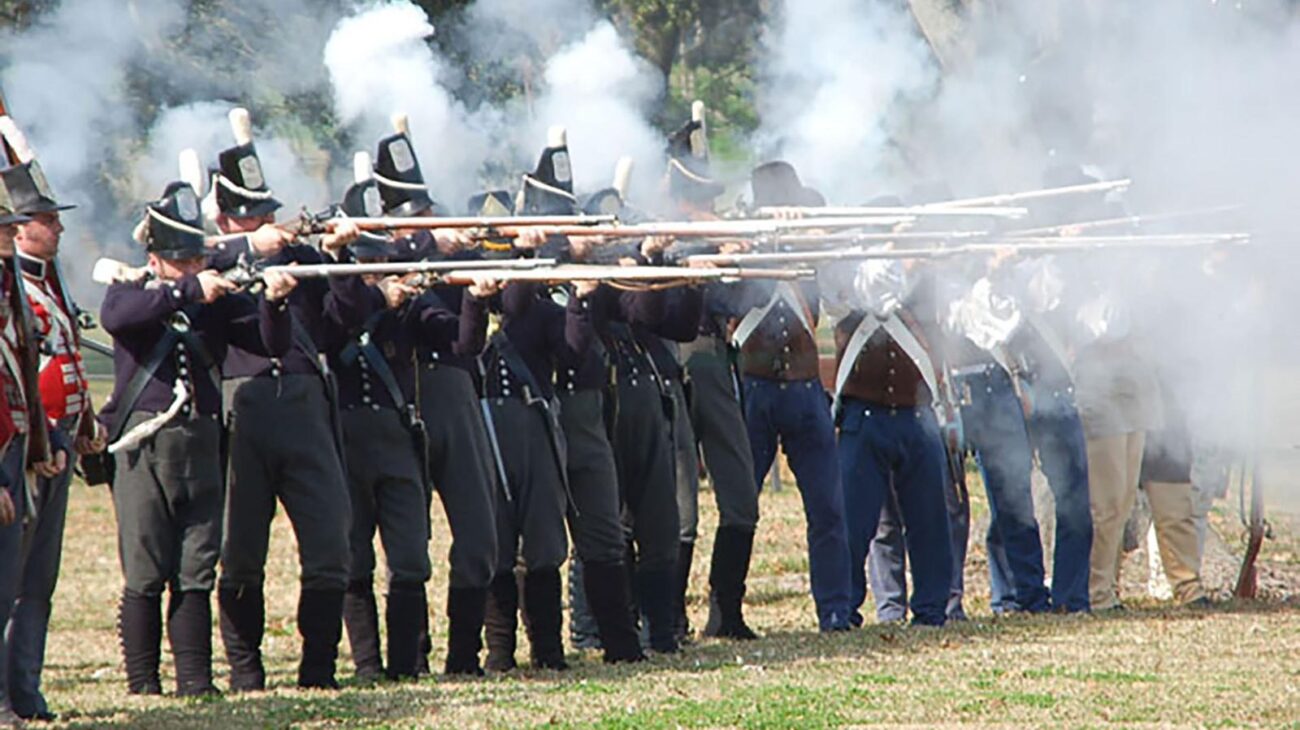
Chalmette Battlefield is at 1 Battlefield Road in Chalmette. Admission is free. The grounds and visitor center are open daily, 9:30 a.m. to 4:30 p.m. Ranger talks run daily at roughly 10:45 a.m. and 2:45 p.m. The annual Battle of New Orleans commemoration is held the second weekend of January, with musket firings, military drills, and living history demonstrations. Call (504) 281-0510 or visit the NPS website before you go.