

Blaine Kern could not pay his mother’s hospital bills, so he offered to paint a mural on the wall instead. A surgeon who happened to captain a Mardi Gras krewe saw it and asked him to build floats.
That transaction set up most of what visitors see at Mardi Gras World today. Kern and his father Roy, a sign painter who worked through the Depression lettering the bows of freighters and barges, had built their first float together on a mule-drawn garbage wagon back in 1932. Kern Studios took its modern form in 1947, and one krewe commission led to the next until Blaine was the city’s leading parade designer.
He went to Europe to learn the craft properly, apprenticing with float and costume makers in Italy, France, and Spain. What he brought home changed the scale of Carnival. Double-decker floats, multi-unit floats, and on-board animatronics all trace to him, and the nickname Mr. Mardi Gras stuck for the rest of his life. He died in 2020 at 93, and his son Barry now runs the company.
Kern Studios builds floats for 18 krewes each year, including Rex and Zulu. The work extends well past Carnival into props and parades for Disney, Six Flags, and Universal Studios, and the company built the Chick-fil-A cows that stand on billboards nationwide.
The attraction opened in 1984 after enough people asked for private tours of the studio that the family decided to let the public in. It started in Algiers and later moved to the riverfront warehouse at 1380 Port of New Orleans Place, near the convention center.
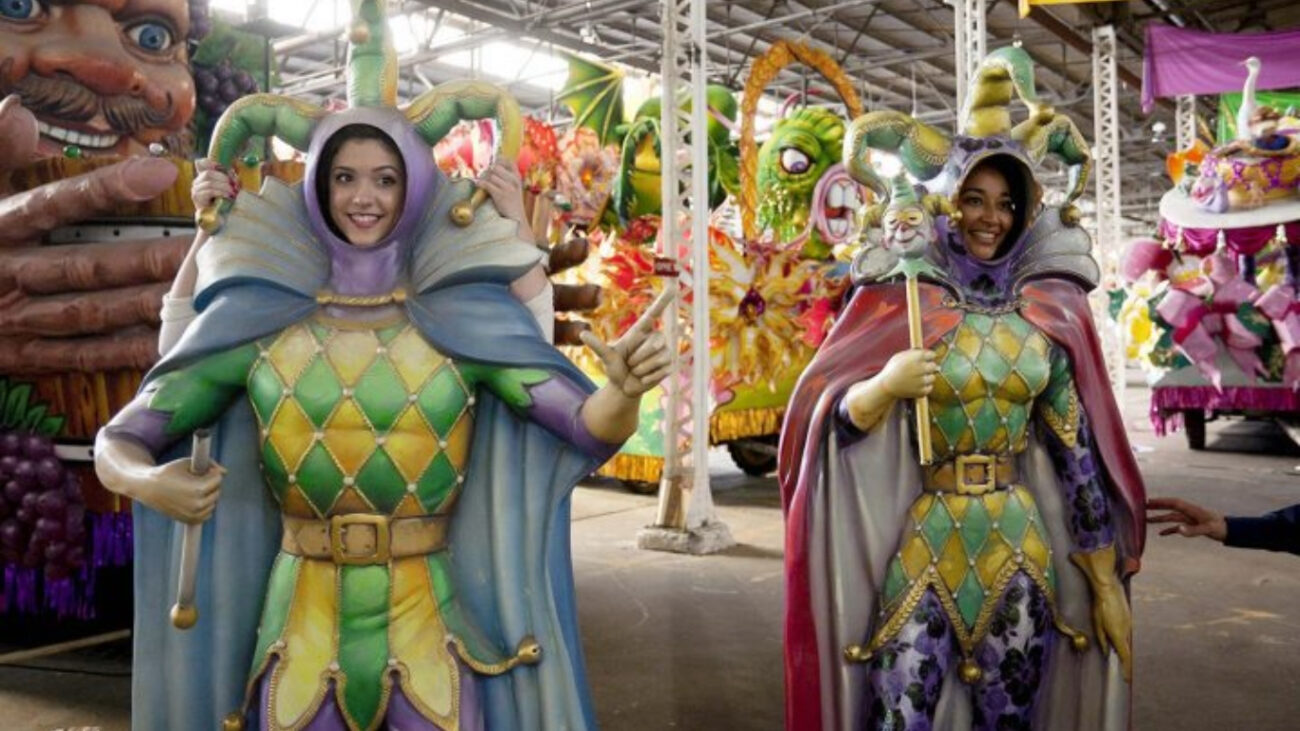
The appeal is that nothing stops for visitors. Painters and sculptors work on floats while tour groups walk through, and a Condé Nast Traveler writer described it as being let in on a secret. The guided tour runs about an hour through the float den, with props, sculptures, and half-finished figures stacked to the ceiling. Admission includes a taste of king cake and the chance to try on Carnival costumes. Photography is encouraged throughout.
Groups can add team-building activities, including mask-making, a mini float build, and a mixology class. The property also books private events through River City Venues.
Doors open seven days a week from 9 a.m. to 5:30 p.m., with first admission at 9:30 and last admission at 4:30. The attraction closes on Christmas, Thanksgiving, Easter, and Mardi Gras Day, which is a reasonable joke on itself.
Getting there is easier than the address suggests. A free shuttle runs from select hotels and downtown destinations, and visitors can call (504) 361-7821 to arrange a pickup. On-site parking costs $20 for anyone driving. The floors are concrete throughout, so comfortable shoes help.
Tickets are worth buying ahead during busy seasons, since timed slots fill. Current listings put adult admission around $29.95, with reduced rates for children, seniors, and military, and children under 2 free.
Blaine Kern spent his last years as an international ambassador for Carnival, which is a formal title for a man who started with a mural he painted because he had no money.