

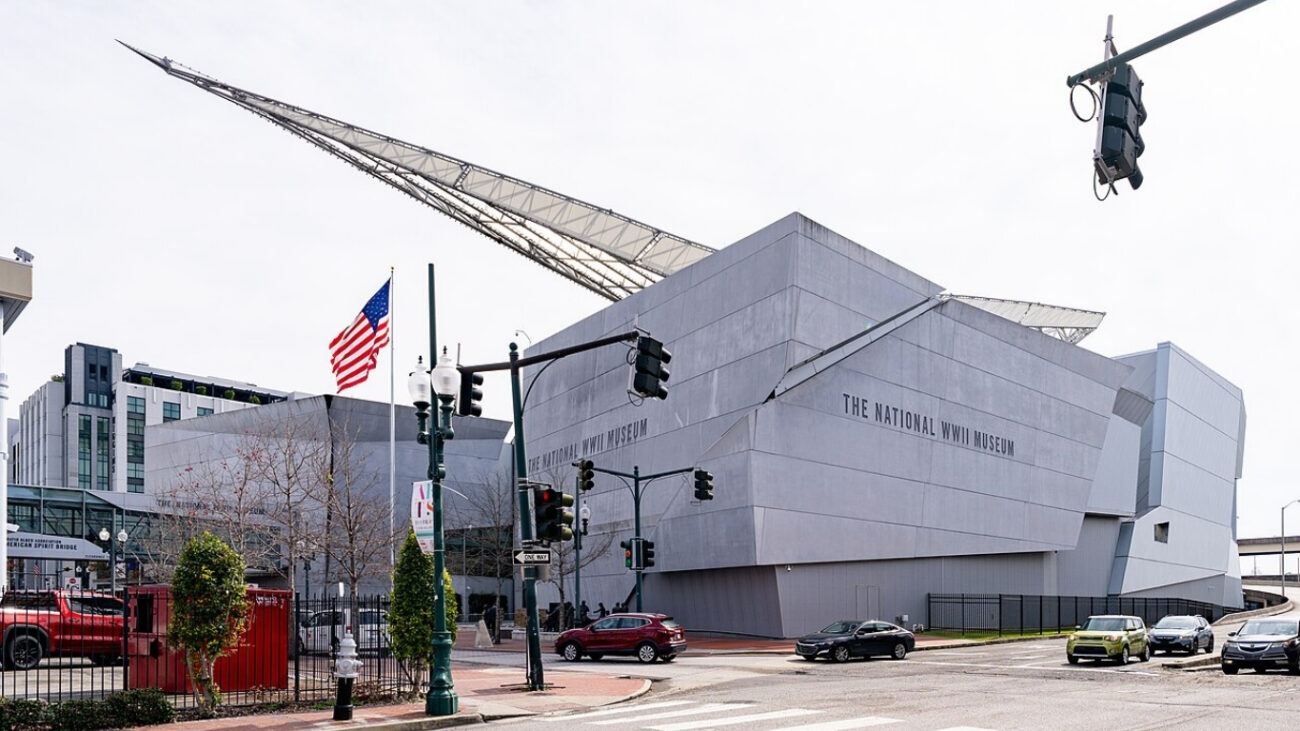
Historian Stephen Ambrose spent decades collecting oral histories from D-Day veterans before realizing the country had no museum built to hold them.
He founded The National WWII Museum in New Orleans for a specific reason. Andrew Jackson Higgins and 30,000 Louisiana workers designed, built, and tested 20,000 Higgins boats here, the landing craft that carried American soldiers ashore in every major amphibious assault of the war. Eisenhower once called Higgins the man who won the war.
The campus now spans multiple pavilions across several blocks of the Warehouse District, and the scale catches visitors off guard. The Louisiana Memorial Pavilion holds Arsenal of Democracy, which covers the home front. Campaigns of Courage houses Road to Berlin and Road to Tokyo, two immersive gallery sequences that walk through the European and Pacific theaters. The Liberation Pavilion, the newest major addition, deals with the war’s aftermath and legacy. Special exhibits rotate through, with Come Back Fighting: USS New Orleans at War currently on view.
Pacing matters more here than at most museums. The museum publishes four separate itineraries running from two hours to two days, which is a fair signal of how much there is. A second-day pass costs $15 within a week of the first visit, and anyone planning three days should price a membership instead.
Admission runs $37 for adults, $34 for seniors 65 and up, and $27 for students, military with ID, and visitors with accessibility needs. Children under 5 and WWII veterans enter free. That ticket covers every exhibit building, current special exhibits, and the Final Mission: USS Tang Submarine Experience, a 15-minute piece that puts visitors inside a submarine on its last patrol.
Two experiences cost extra. Beyond All Boundaries is a 48-minute 4D film narrated by Tom Hanks, showing at the top of each hour from 10 a.m. to 4 p.m. The Priddy Family Freedom Theater runs 30 minutes twice an hour. Each costs $9, and a combo runs $12.
Several practical details make a difference. The galleries are kept cool to protect the artifacts, and the museum openly tells visitors to bring a sweater. Benches are limited across a large campus, so anyone who needs to sit often should take one of the complimentary wheelchairs or bring a portable stool. Photography without flash is allowed, recording is not, and only sealed water bottles come into the galleries. There is no audio tour, though docent tours run daily. Visitors can leave and return the same day until 5 p.m.
Food is handled across the campus. The American Sector serves a garden-to-table lunch, the Jeri Nims Soda Shop covers breakfast and quick bites, and the on-site Higgins Hotel adds Café Normandie, Kilroy’s Bar & Lounge, Rosie’s on the Roof, and a grab-and-go market.
The garage at 1024 Magazine charges $8 for the first hour and $25 for seven to twelve hours, with no spaces for motorcycles or vehicles over 6 feet 8 inches. Nearby surface lots handle oversized vehicles. Doors open daily at 9 a.m. and close at 5 p.m., with closures only on Mardi Gras Day, Thanksgiving, Christmas Eve, and Christmas.
The museum cites Department of Veterans Affairs figures showing 45,418 surviving American WWII veterans as of 2025, out of 16.4 million who served. That number explains the urgency behind everything on the campus.