

Budget travel shouldn’t mean compromising on comfort or environmental values, yet most economy hotels force exactly that choice. The Hi Inn Self-Service in Ningbo eliminates this frustration through radical automation and modular design that makes sustainability profitable.
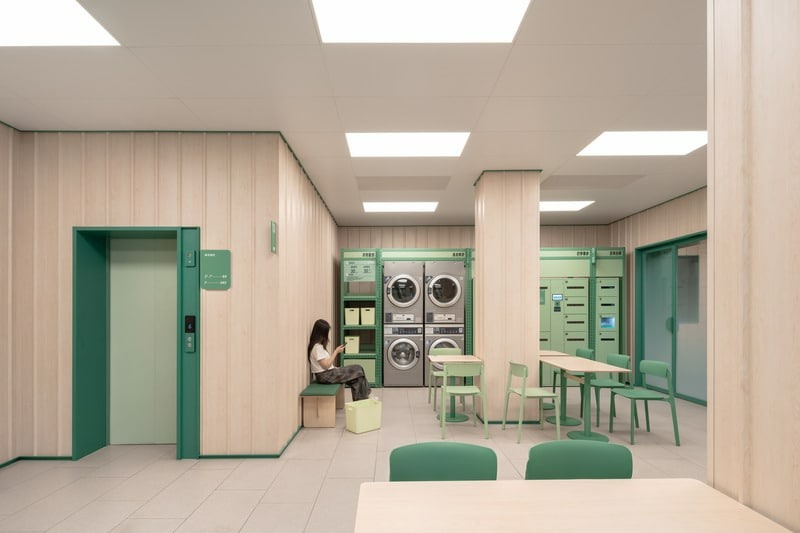
Vermilion Zhou Design Group’s Shanghai-based team has reimagined the entire guest experience around self-sufficiency. Check-in happens via digital kiosks. Laundry and dining operate through automated stations. The ultra-compact lobby prioritizes intuitive navigation over traditional concierge services.
This isn’t just cost-cutting disguised as innovation—it’s responding to genuine traveler preferences. Recent industry research shows 80% of guests willingly stay at hotels with fully automated front desk operations.
Modular Construction Meets Digital Hospitality
Prefabricated “wash walls” and “wardrobe walls” accelerate construction while supporting flexible deployment across locations.
The hotel’s backbone lies in its modular construction system. Prefabricated units—from integrated bathroom “wash walls” to media-equipped “wardrobe walls”—slot together like oversized LEGO blocks.
This approach slashes construction time while enabling rapid scaling for chain deployment. Technical infrastructure gets baked into each module, eliminating the messy retrofitting that plagues traditional hotel builds.
More impressively, over 80% of construction materials can be recycled or repurposed. Steel panels, angle frames, and standardized hardware disassemble cleanly for future renovation or relocation. It’s circular economy principles applied to hospitality real estate—something the industry has talked about for years without meaningful action.
The visual approach stays deliberately restrained. Rather than masking budget constraints with flashy decor, the design uses light control and material choices to create calm, navigable spaces.
Think Muji’s aesthetic philosophy applied to overnight accommodation—purposeful minimalism that actually serves the user experience. By minimizing staff requirements and utilizing efficient, prefabricated construction, operational costs drop significantly, enabling more accessible room rates for budget-focused travelers.
This model demonstrates that automation and sustainability aren’t luxury add-ons but essential operational efficiencies. For travelers seeking affordable accommodations without environmental compromise, Vermilion Zhou’s approach offers a compelling blueprint for the future of budget hospitality.