

The Mississippi is the reason New Orleans exists, and it’s also the thing most visitors never actually feel. Levees block it from the street grid; the tourist riverfront is manicured and commercial. These three experiences put you on the water or at the edge of it, where the scale and industrial weight of the river become real.
Algiers Ferry— Canal Street Terminal, foot of Canal St., CBD
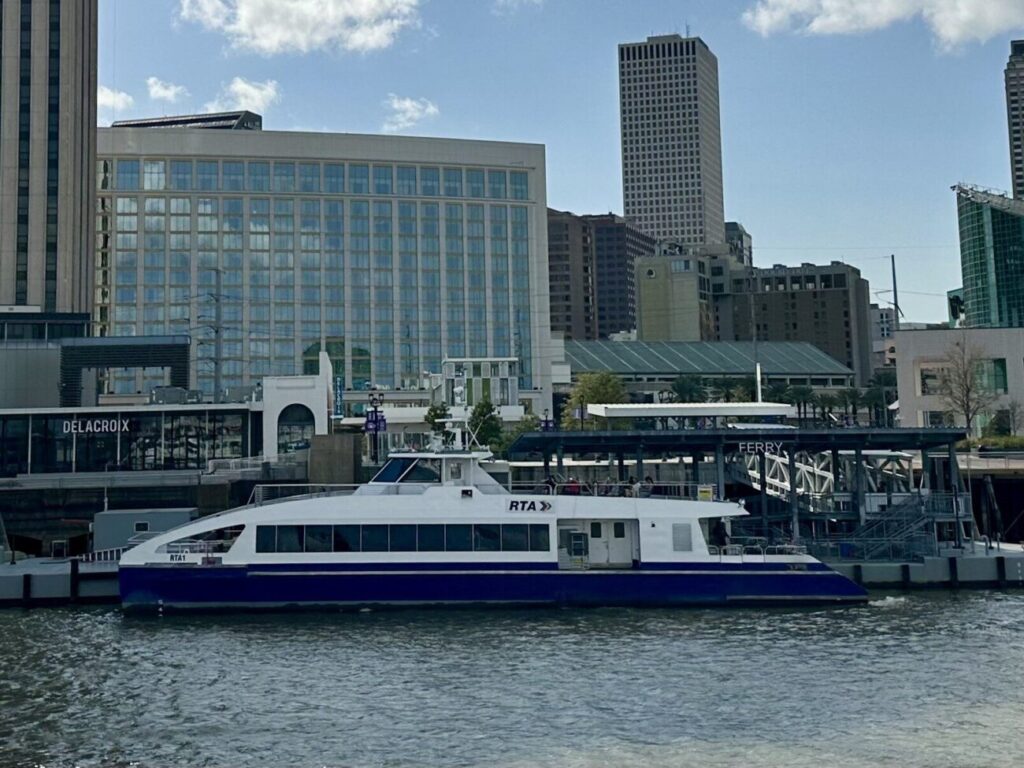
Regular ferry service between Canal Street and Algiers Point has run since 1827, making this one of the oldest continuous transit crossings in the country. The current vessels are 105-foot aluminum catamarans operated by NORTA, each carrying up to 149 passengers. The ride itself takes about five minutes across one of the widest, fastest stretches of navigable river in North America — long enough to understand why early settlers found the crossing genuinely dangerous.
The view going west shows the full sweep of the city skyline from the water, the angle that explains the Crescent City name. The return crossing puts you square in the current with cargo ships and tugboat convoys moving at close range. Pedestrians and cyclists pay $2 each way; cash only. Departures run every 30 minutes from both sides. Board at the foot of Canal Street next to the Aquarium of the Americas. Algiers Point on the west bank has Victorian cottages, the Robert E. Nims Jazz Walk of Fame, and the Old Point Bar — enough to justify a longer visit.
Steamboat Natchez— Toulouse Street Wharf, French Quarter
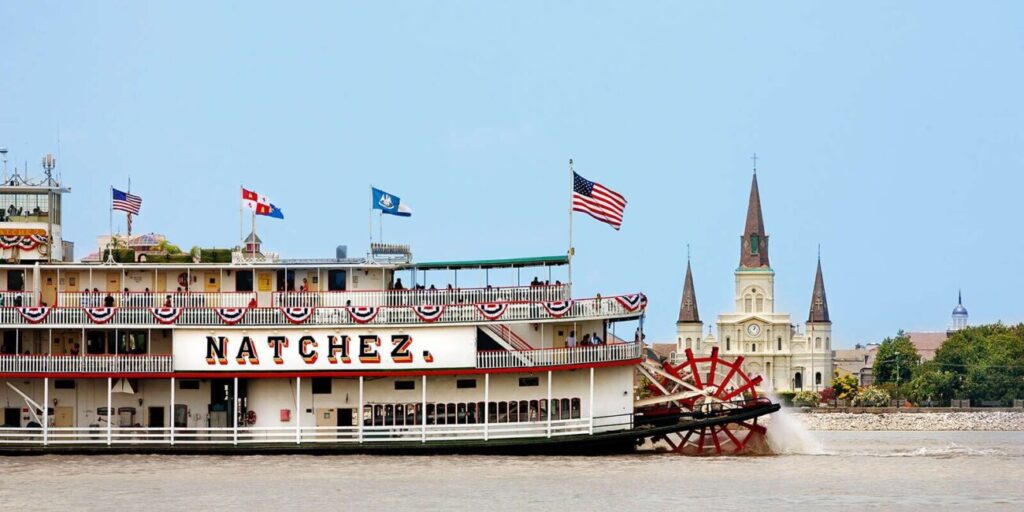
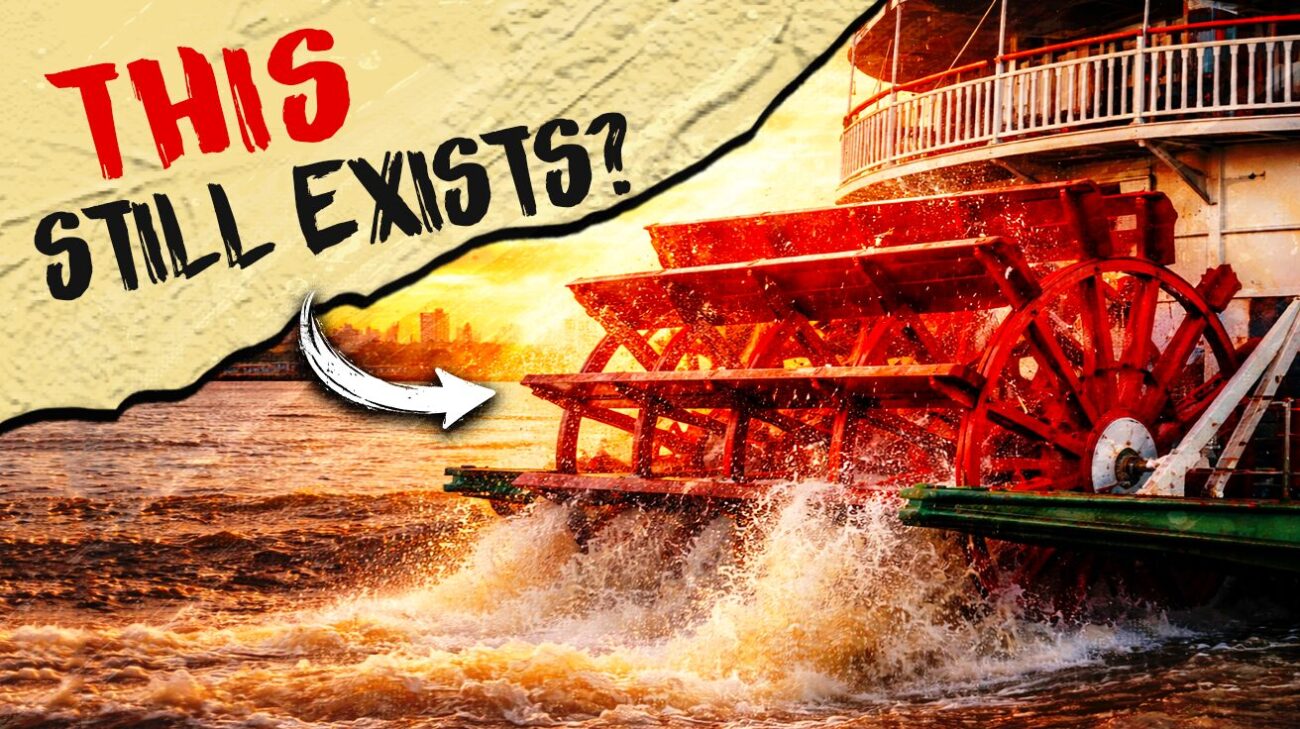
Built in 1975 at Bergeron Shipyards in Braithwaite, Louisiana, 14 miles downriver from its dock, the Natchez is the ninth steamboat to carry the name in a lineage stretching to 1823. It is one of the last two true steam-powered sternwheelers still operating anywhere on the Mississippi River system. The steam engines themselves are older than the boat — built in 1925 for a U.S. Steel Corporation sternwheeler called the Clairton, and still running on live steam today. The engine room is open to passengers on all cruises.
The copper bell was cast from 250 melted silver dollars to produce a purer tone. The steam whistle is a salvaged antique. The 32-note steam calliope plays before departure from the dock, audible across the French Quarter. Daytime harbor cruises last two hours with narrated historical commentary. Evening dinner cruises include live jazz from the Dukes of Dixieland. Book at steamboatnatchez.com; the boat docks at the Toulouse Street Wharf behind JAX Brewery.
Crescent Park— Elysian Fields to Mazant St., Bywater
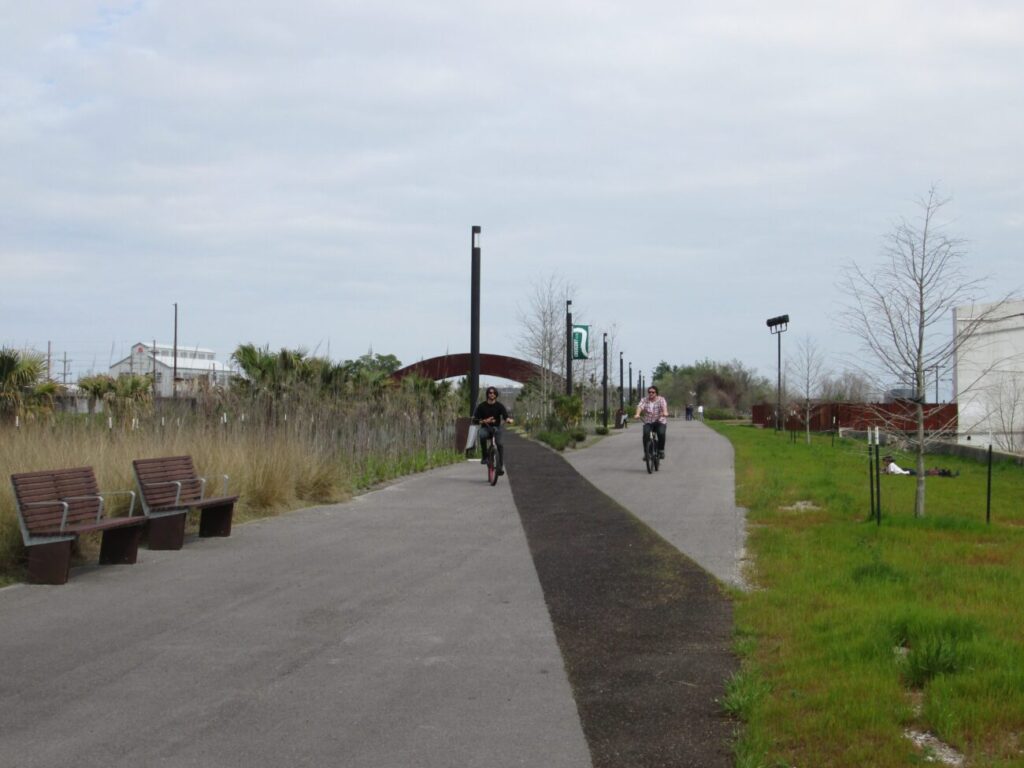
Before this park opened in February 2014, residents of the Marigny and Bywater had no safe way to reach the riverbank — active railroad tracks and industrial wharves formed a continuous barrier between the neighborhoods and the water. The park was designed by Hargreaves Associates with local firm EskewDumezRipple as part of the post-Katrina Reinventing the Crescent initiative. The design team chose to work with the industrial bones of the site rather than erase them — defunct railroad tracks become the geometry of the pathways, rusted cranes remain in place as structural landmarks, and wharf foundations anchor two transformed open-air pavilions.
The Piety Street Bridge — locally called the Rusty Rainbow — arches in a dramatic curve over the active rail corridor and floodwall to connect the Bywater to the park’s midpoint. From the top of the bridge, you get an unobstructed view of the river’s bend and the full industrial reach of the working port. The 1.4-mile trail runs from Elysian Fields Avenue to Mazant Street and takes about 40 minutes at a walking pace. Free and open daily; enter at Elysian Fields, Piety Street, or Bartholomew Street. The Piety and Bartholomew entrances have free parking lots.