

Grocery stores of the 1970s weren’t just places to grab milk and bread—they were community theaters where weekly shopping trips played out like neighborhood rituals. The aisles felt manageable then, choices less paralyzing than today’s wall of yogurt varieties that somehow all taste the same. Chains like A&P, Kroger, and Safeway weren’t faceless corporations but familiar landmarks where families gathered weekly, pushing metal carts with squeaky wheels across linoleum floors. This was shopping before algorithms knew what you wanted—when discovering products meant physically encountering them on shelves rather than having them materialize in your feed like targeted apparitions. For a broader look at how supermarkets became central to American life, see the history of American supermarkets.
13. A&P: The Last American Grocery Giant

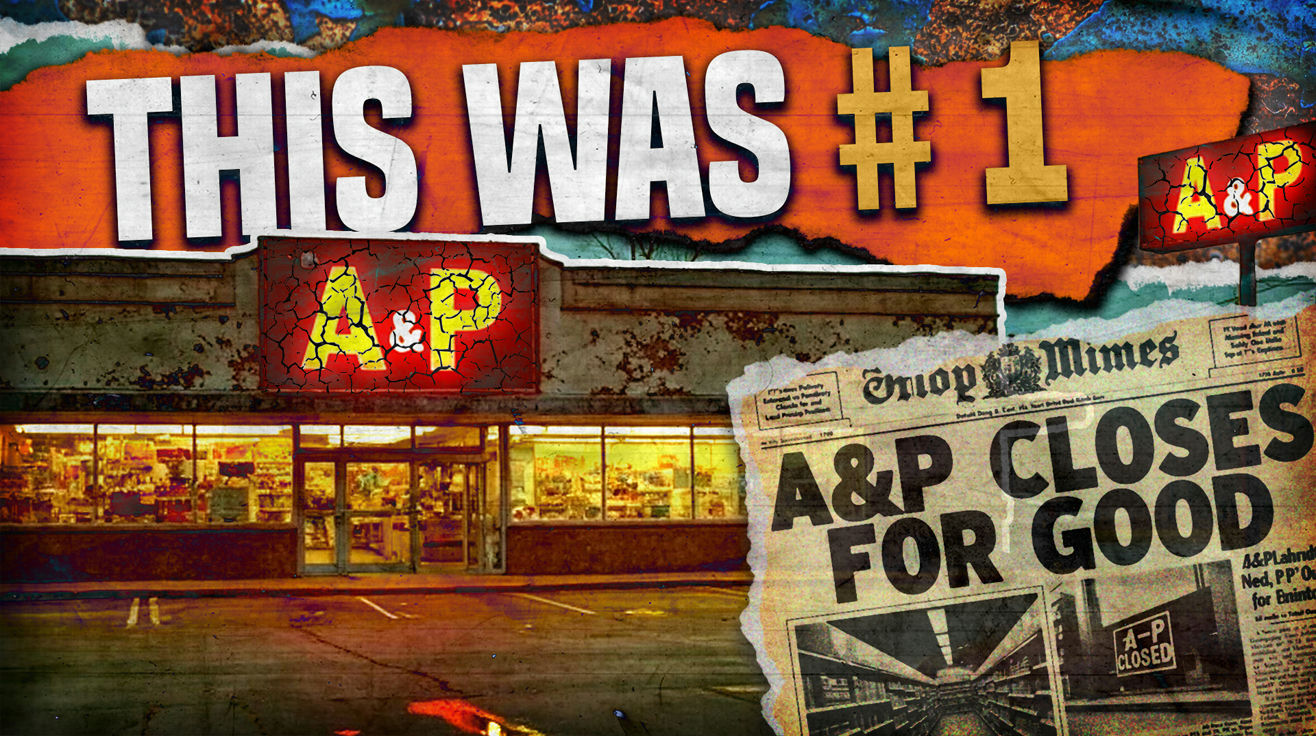
A&P began its retail journey in 1859, eventually becoming America’s grocery goliath from 1915 to 1975. Their revolutionary economy store model transformed how Americans shopped, with millions developing fierce loyalty to their 8 O’Clock coffee and Jane Parker baked goods. The ritual of watching groceries disappear into those sturdy brown paper bags became a weekly constant for families across the country—each bag a promise of meals shared around tables where phones stayed in pockets.
Like a dinosaur watching the meteor approach, A&P struggled to evolve as nimbler competitors emerged. Its permanent closure in 2015 marked the end of a 156-year run, proving that even retail titans can topple when they mistake customer loyalty for guaranteed survival. For a detailed account of A&P’s rise and fall, see the New York Times coverage of A&P’s corporate legacy.
12. West Coast Innovators: Alpha Beta and Lucky’s California Revolution

Alpha Beta pioneered something genuinely innovative when it opened in California in 1917—alphabetical store arrangement. This brilliantly simple layout made shopping more intuitive decades before user experience became a corporate buzzword. The chain also created coffee shops that became part of the casual dining landscape, where conversations lasted longer than the time it takes to scan a QR code. For a glimpse into Alpha Beta’s store design and history, see Alpha Beta store innovation.
American Stores acquired the business in 1961, expanding beyond groceries into electronics. The Alpha Beta name vanished after 1978, yet its approach to store organization continues influencing modern retail design. Meanwhile, Lucky Stores grew from Charles Crouch‘s 1935 vision through strategic acquisitions, eventually absorbing Alpha Beta’s legacy and surviving as one of the few chains that adapted rather than disappeared.
11. The Pennsylvania Price Wars: Food Fair and Pantry Pride

Pantry Pride emerged from Food Fair‘s earlier Pennsylvania operations in the early 1970s, both chains fighting the good fight for budget-conscious shoppers who counted every penny before self-checkout machines started counting everything else. Their strategy hinged on variety and competitive pricing that drew families through doors where employees actually remembered your name and your usual order.
Food Fair‘s 1978 bankruptcy sent shockwaves through communities that had built weekend routines around these stores. Pantry Pride gradually faded from the retail landscape, becoming merely a footnote in the evolution of American supermarkets—another casualty of the efficiency revolution that prioritized speed over human connection.
10. Midwest Memories: Where Shopping Meant Stopping to Chat

Red Owl began as a coal business in 1922 with the charmingly straightforward slogan “be wise burn red owl coal” before expanding throughout the upper Midwest, where its iconic logo became as familiar as a neighbor’s face. Shopping often became a social occasion, turning errands into community interactions that today’s tap-and-go transactions simply can’t replicate. For more on this iconic regional chain, see Red Owl grocery history.
National Tea started in Chicago in 1899 and expanded rapidly through the heartland. By the late 1920s, it operated over 1600 stores across the Midwest, their red and white signage visible from blocks away—beacons of household necessities in neighborhoods where people knew each other’s grocery lists better than their Instagram handles.
9. Eagle Food Centers: The Self-Service Revolution

Eagle Food Centers began in 1893 and transformed grocery shopping by introducing the radical concept of self-service. This innovation freed customers to browse without assistance—a shopping revolution that now seems as obvious as wheels on luggage. Lucky Stores acquired the chain in 1968, rebranding it as Eagle Discount Supermarkets during an era when discount meant value, not disposability.
Financial troubles mounted through the late 1990s, and the business finally shuttered in 2003, unable to soar in the increasingly competitive grocery landscape where bigger birds were circling overhead with supply chains that stretched across continents instead of counties.
8. Skaggs Companies: The Retail Dynasty

Samuel M. Skaggs founded his company in 1915, creating what would become a multi-generational retail empire. After merging with Safeway in 1926, Skaggs evolved into American Stores, spreading its influence throughout the industry like spores on favorable wind. His vision of combining convenience with community would seem revolutionary to today’s shoppers who navigate stores designed more like warehouses than gathering places.
Skaggs helped develop innovative food/pharmacy combinations that now seem standard but were revolutionary at the time. Its vision shaped modern retail, demonstrating how one company’s roots can transform an entire industry’s landscape.
7. Colonial Stores: The Southern Evolution

Colonial Stores began as David Pender Grocery Company in 1900, amassing 244 stores by 1926. It acquired Albert supermarkets and Stop and Shop in 1955, and during the 1970s, Colonial metamorphosed into Big Star—a retail butterfly emerging from its corporate chrysalis when rebranding meant evolution, not just marketing.
At its peak, Big Star operated hundreds of stores across the Southern US, creating spaces where Saturday shopping meant seeing the same familiar faces week after week. This evolution highlights the dynamic nature of retail branding, where companies shed their skins and emerge as something new when markets demand change.
6. Regional Heartland Heroes: Big Bear and Hills

Big Bear Stores inspired fierce devotion in Ohio and West Virginia after its 1934 founding. By the 1980s, it operated over 100 stores, offering affordable goods to communities where shopping local wasn’t a trendy hashtag but a practical reality that kept neighbors connected. Friday evenings at Hills Supermarkets in the New York area hummed with similar energy as families prepared for weekend meals, aisles filled with neighbors exchanging recipes and gossip in equal measure.
Both chains eventually succumbed to corporate competition that prioritized efficiency over the kind of patient service that made grocery shopping feel less like a chore and more like a community ritual. Their closures left voids in customers’ weekly routines that online ordering and curbside pickup simply can’t fill.
5. California Dreamers: Gemco and Fazios

Gemco pioneered the modern mega-store concept after its 1959 founding in California, when shopping for groceries and a new toaster in the same place seemed revolutionary rather than routine. This one-stop model appealed to busy families who valued efficiency before convenience became our collective religion—back when one-stop shopping meant more variety, not just more stuff. For a retrospective on Gemco’s influence, see Gemco’s retail legacy.
Fazios, originally Shopping Bag Food Stores, featured popular ‘Wine Seller’ departments with impressive selections that made everyday shopping feel slightly more sophisticated than grabbing milk and eggs. The chain understood that grocery shopping could be elevated without being pretentious, creating experiences that today’s sterile big-box stores struggle to replicate despite all their data and demographics.
4. The Transformation Stories: Furr’s and Value Mart

Furr’s began as a grocery store in Texas in 1904 and expanded to New Mexico before making an unexpected pivot into the restaurant business, transforming into a cafeteria chain. Regular shoppers were surprised to find their familiar grocery aisles replaced by steam tables and trays—a retail identity crisis that actually worked, proving that sometimes reinvention beats extinction.
Value Mart represented an attempt to merge diverse shopping experiences when department stores still ruled retail. Founded in 1950s Seattle, it aimed to combine grocery shopping with broader merchandise but struggled to gain market traction, demonstrating the importance of focused expertise in an era when trying to be everything to everyone often meant becoming nothing to anyone.
3. The Small-Town Lifelines: Hecht’s and QFI

Hex emerged in 1959 as both a community center and retail option for small towns across West Virginia, Western Maryland, Ohio Valley, Indiana, Kentucky, and North Carolina. In many locations, Hex functioned as a rural retail oasis where shopping meant seeing familiar faces and catching up on local news between the produce and checkout—social media before there was social media.
QFI built strong customer loyalty in the Pacific Northwest through genuine commitment to product quality and friendly service, with helpful employees ready to assist shoppers in ways that feel almost quaint in today’s scan-it-yourself world where human interaction requires a special request. Both chains proved that smaller could be better, until bigger became cheaper.
2. The Ambitious Experiments: Omni Superstore and Lucky’s Legacy

Omni Superstore launched in 1987 as Dominick’s Finer Foods‘ attempt at creating a one-stop shopping destination when retail was entering its supersize era. The concept peaked at seventeen Illinois locations before shifting consumer preferences led to its 1997 phase-out—a retail shooting star that burned bright but briefly in Chicago’s competitive market.
Lucky Stores survived where others failed, growing through strategic acquisitions and eventually operating under the Save Mart umbrella as one of the few retail survivors in an industry littered with extinct brands. Its longevity proves that adaptation beats innovation when innovation loses sight of what customers actually want: decent products, fair prices, and the occasional human conversation.
1. Bohack: When Grocery Stores Built Communities

Bohack provided a small-town shopping experience within the urban jungle of New York City after Henry C. Bohack founded it in 1887. The chain expanded throughout NYC and Long Island, with its red and white signs becoming local landmarks as familiar as subway entrances or corner delis. These weren’t just stores—they were neighborhood anchors where community happened organically. For a nostalgic look at this beloved chain, see Bohack supermarket legacy.
Stores functioned as social centers where neighbors met and conversed about everything from weather to world events, creating bonds in a city known more for anonymity than intimacy. Bohack’s welcoming atmosphere proved that even in the busiest places, people craved connection over convenience. The chain declined and collapsed in the late 1970s, leaving behind empty storefronts and memories of an era when grocery shopping meant human connection rather than algorithmic efficiency. In losing these spaces, we didn’t just lose stores—we lost the weekly rituals that turned strangers into neighbors, one conversation at a time.