

New Orleans ironwork did not arrive with the French or the Spanish, even though both colonial powers get most of the credit in postcard captions. Historian Marcus Christian traced most of the city’s early wrought and cast iron back to enslaved craftsmen from West Africa, men who apprenticed under French blacksmiths in the 1700s and continued the trade under Spanish and American masters as the colony changed hands. These three stretches of the Upper Quarter carry that legacy in iron that still hangs over the sidewalk today.
Royal Street Balcony Corridor
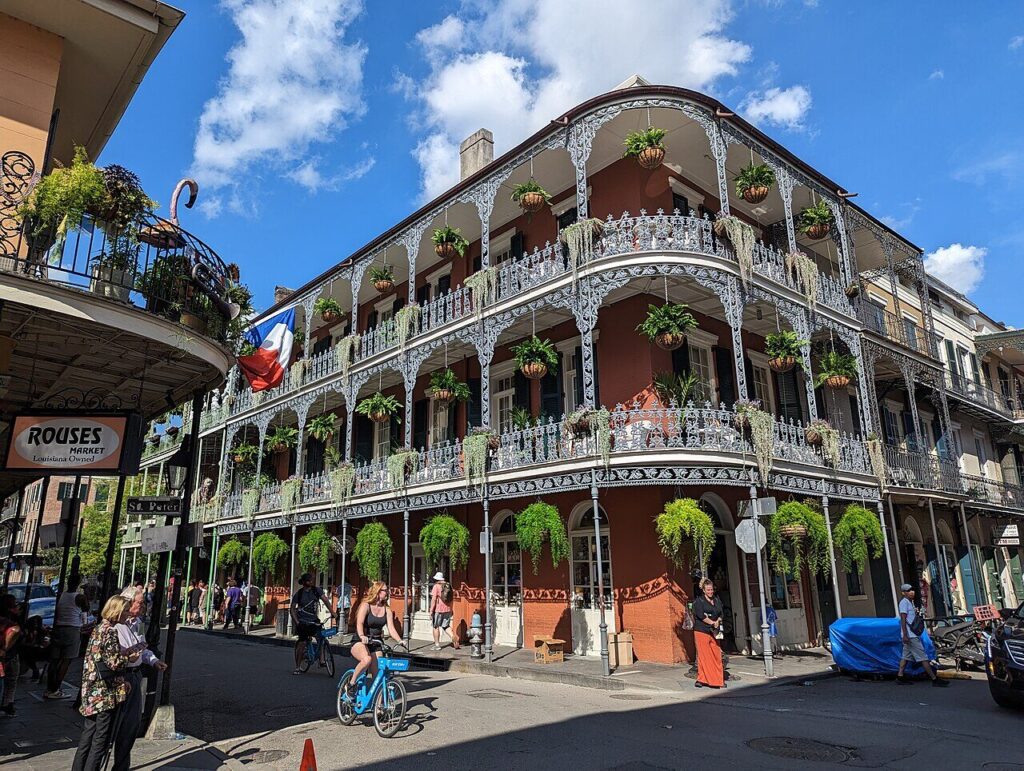
The block of Royal Street running through St. Peter holds some of the most magnificent iron-lace streetscapes in the entire French Quarter, a concentration of cast and wrought balconies dense enough that tour guides routinely run out of buildings to point at before they run out of stories. The LaBranche House, built in 1835, anchors the corner and remains one of the most photographed buildings in the city because of its elaborate cast-iron galleries, heavy with oak leaf and acorn motifs that repeat identically across the facade, a hallmark of the industrial casting process that came later in the city’s ironwork history.
A few doors down, the Bosque House at 617 Chartres carries an earlier and rarer example: a hand-forged monogram balcony dating to 1795, built for Spanish merchant Bartolome Bosque. Tour guides have nicknamed the design around the initials the cannon motif, though its original intent was almost certainly decorative scrollwork in the Spanish colonial style. The contrast between this hand-wrought balcony and the mass-produced cast iron a block away tells the whole story of how the craft evolved, from individually hammered pieces made by skilled hands to repeatable industrial patterns that could dress an entire building cheaply.
Walk Royal Street between St. Peter and St. Louis in the morning, before the afternoon crowds gather, for the clearest view of both styles side by side.
The Cabildo Portico Gates
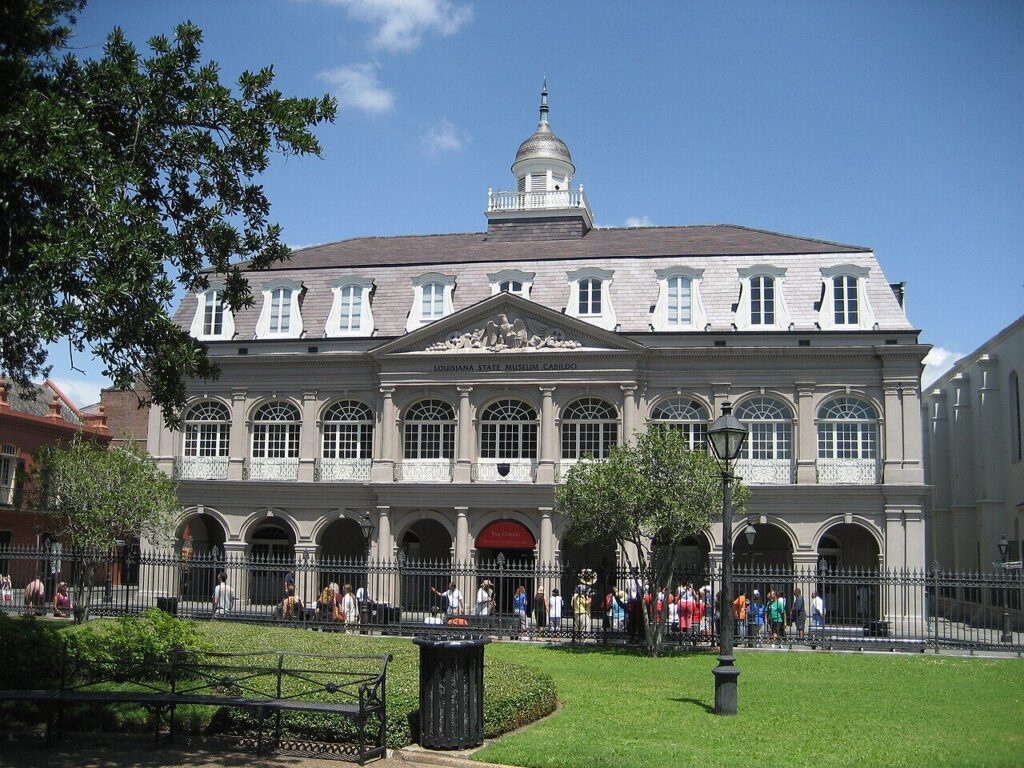
The Cabildo at 701 Chartres Street went up between 1795 and 1799 under Spanish governor Alejandro O’Reilly’s commission, replacing an earlier structure destroyed in the catastrophic 1788 fire. The building’s wrought ironwork, executed by Marcelino Hernandez, an immigrant blacksmith from the Canary Islands, was called perhaps the finest example of the Spanish period by historian Samuel Wilson. The delicate scrollwork along the portico and gates reflects a level of hand craftsmanship that predates the cast-iron boom of the mid-1800s by decades.
The portico itself carries weight beyond its decoration. Enslaved people were sold under this same colonnade during the building’s tenure as the seat of Spanish colonial government, a fact the Louisiana State Museum now addresses directly in its exhibits rather than leaving unspoken. Standing beneath ironwork this fine while reading that history side by side is one of the more sobering experiences available on a walk through Jackson Square, and it’s free to do from the sidewalk without paying museum admission.
The Cabildo sits on Jackson Square at 701 Chartres Street, with the exterior ironwork visible at any hour. The museum interior is open Tuesday through Sunday from 10am to 4:30pm.
Madame John’s Legacy Railings
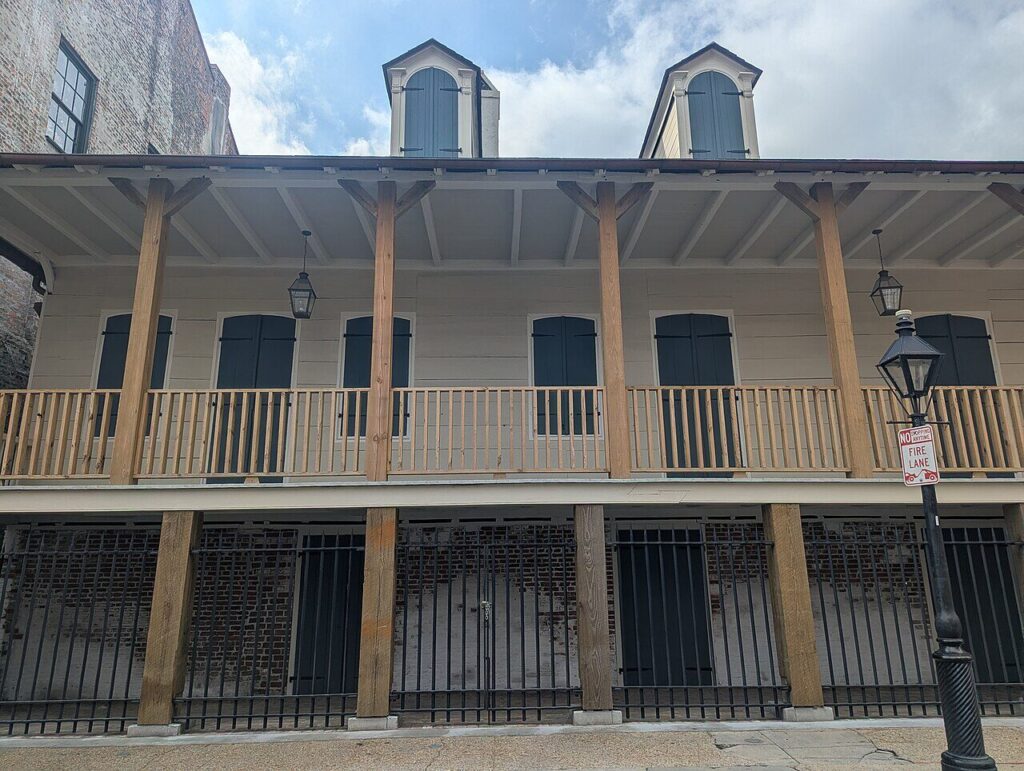
Madame John’s Legacy at 632 Dumaine Street is, according to multiple architectural surveys, the only surviving example of true French colonial raised-cottage architecture left in the Quarter, built in 1788 immediately after the fire that destroyed its predecessor. The building’s design duplicates the French colonial house type that dominated the city before Spanish rule reshaped its architectural identity, which makes its iron railings a rare physical link to a building tradition that otherwise exists only in historical drawings.
The railings here run simpler than the elaborate galleries found a few blocks south on Royal Street, reflecting both the earlier construction date and the practical, less ornamental ironwork style that characterized French colonial buildings before the more decorative Spanish and later American influences took hold. That simplicity is its own kind of historical evidence. It shows what ironwork looked like in New Orleans before the elaborate cast and wrought patterns most visitors associate with the city had fully developed.
Madame John’s Legacy is at 632 Dumaine Street, with the building’s exterior ironwork visible from the sidewalk at any time. The interior operates as a property of the Louisiana State Museum, with limited public hours that should be confirmed before planning a visit inside.