

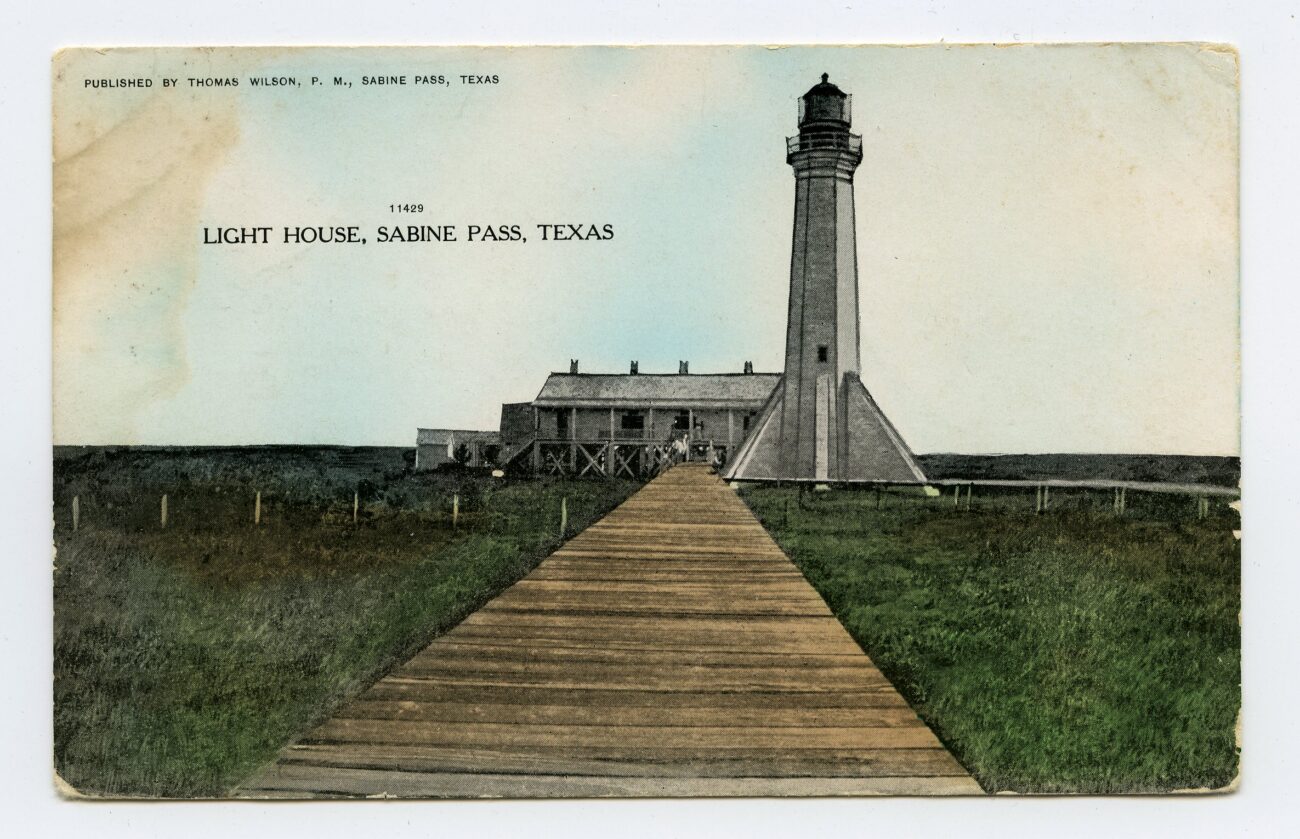
The Sabine Pass Lighthouse looks like it’s about to launch into space. An 85-foot brick octagon rises from the marshland where the Sabine River meets the Gulf, its base splayed into eight finlike buttresses that give it the shape of a rocket ready for liftoff. Built in 1856, abandoned since 1952, it still stands in the wetlands at the Louisiana-Texas border.
If you visit at high tide, one to two inches of water surround the base. You’ll need boots. At low tide, you can walk right up across the muddy wetland to touch the 18-inch-thick brick walls.
Getting there requires permission and patience. Call the Johnson Bayou Library at (337) 569-2892 with your name, vehicle description, and visit date. They email Cheniere Energy, which built an LNG terminal nearby and now controls access to the lighthouse property. Security escorts you through the plant to a gate that opens onto a three-mile dirt road dotted with cow pies and wandering cattle. The road ends at Lighthouse Bayou, where you’ll either need a small boat to cross or wade through if the water’s low enough. Ships pass by in the distance looking like they’re sailing through grass.
Captain Danville Leadbetter designed those distinctive buttresses for survival. Four extend 10 feet from the base while the other four reach 18 feet, distributing the tower’s massive weight across a foundation of wooden pilings, brick, and shellcrete made from oyster shells and aggregate. Louisiana’s soft marsh soil had already swallowed other lighthouses that were too heavy for the ground. This is the only lighthouse in the country built with buttresses like these, and it’s the reason the tower still stands 170 years later.
The structure tapers upward to a conical dome topped with what was once a copper roof, stolen by thieves years ago. A third-order Fresnel lens once rotated inside the lantern room 85 feet up, flashing white light across Sabine Pass starting in 1857 to guide ships through the channel for 95 years.
The Civil War went dark in 1861 when Confederates extinguished the beacon to hinder Union navigation. Both sides used the tower as an observation post, and a skirmish on April 16, 1863 killed several men at the lighthouse. The light came back on December 23, 1865 after the Confederate surrender.
An 1886 storm created an eight-foot tide that surrounded the tower with five feet of water and washed away every building on the site except the lighthouse itself. The keeper and his girlfriend fled to the upper portion of the tower along with the assistant keeper and his wife as floodwater rose 20 feet around them. Spray reached a window 50 feet up while wind lifted a 100-pound iron trapdoor that had been secured with a five-gallon oil can. They survived.
The 1915 hurricane made the tower vibrate so hard it broke the clockworks that turned the lens. Keepers had to rotate it by hand until repairs could be made. Hurricane after hurricane hit the lighthouse over the next century. Rita, Katrina, storms whose names nobody remembers anymore. The buttresses held.
The Coast Guard deactivated the lighthouse in 1952 when modern navigation made it obsolete. The property bounced between federal agencies and the State of Louisiana before two businessmen bought it at auction in 1986 for $55,000, planning to build a marina or restaurant. Nothing happened. They donated it to the Cameron Preservation Alliance in 2001.
The alliance built a road to the site and recruited volunteers for restoration work. President Andrew Tingler makes the two-hour drive from Grand Lake every other week when he can, dragging his teenage son Jax along. They’ve logged 200 volunteer hours in a year, working one small step at a time with private donations after grant applications kept getting rejected.
The lighthouse still stands alone in the marsh where visitors from Wisconsin, California, Florida, and Texas make the pilgrimage. They call the library, drive the dirt road, wade through water or float across the bayou to stand looking up at an 85-foot brick rocket that’s been pointing at the sky since before the Civil War. The buttresses still hold. The brick hasn’t crumbled yet. Ships still pass in the channel.