

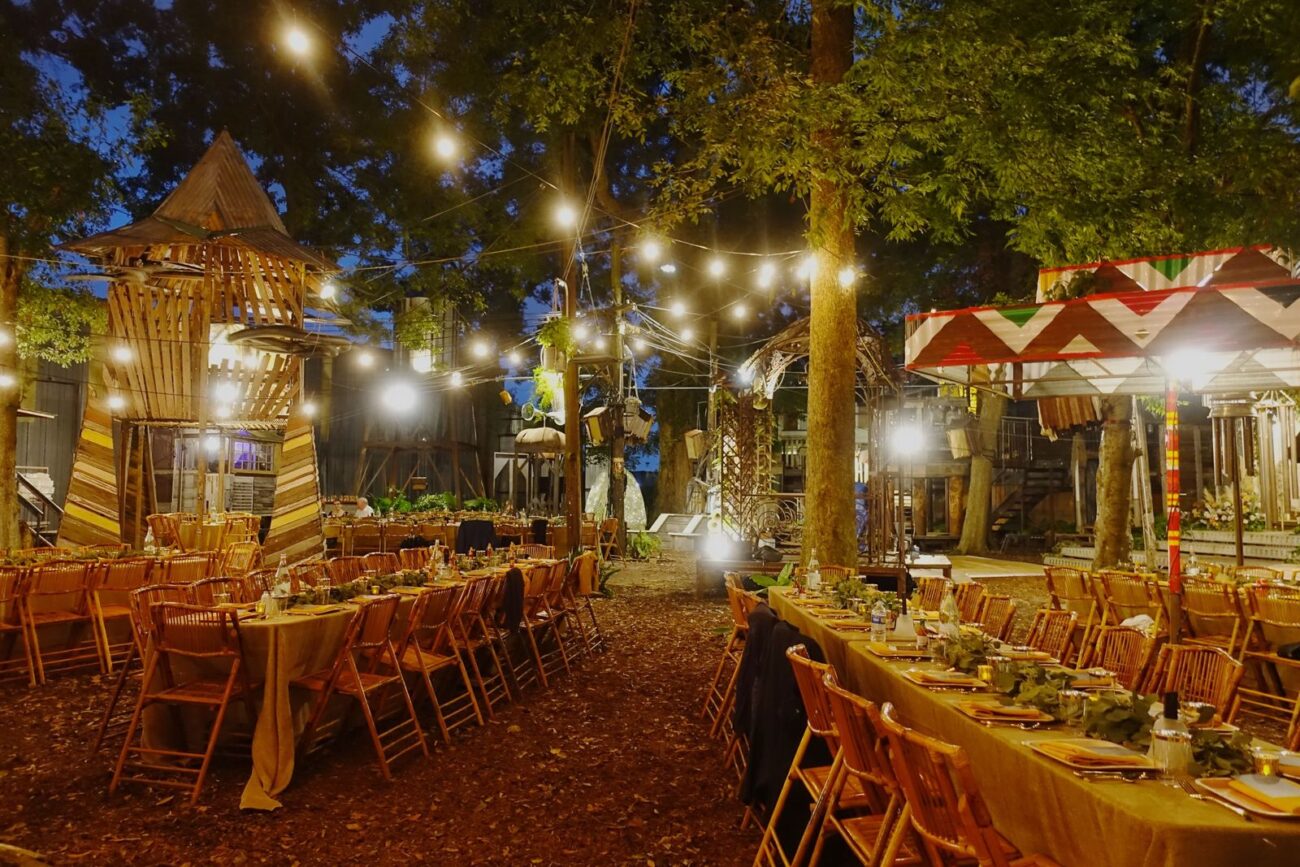
Instruments don’t belong in buildings. They are buildings. That’s the idea behind Music Box Village, where 20 structures function as playable sound installations scattered across a lot in the Bywater. Houses made of corrugated metal produce percussion. Sheds strung with piano wire become giant zithers. Towers filled with bottles hum when wind passes through them.
Delaney Martin and Jay Pennington started the project in 2011. Musicians and artists built the first structures in empty lots around New Orleans, moving the installation several times before settling on a permanent site at 4557 North Rampart Street in 2016. The village operates as an experimental music venue, art installation, and community space where the line between instrument and architecture disappears.
Each structure has a name and a sound. The Singing House features tuned pipes that sing when you play them like an organ. The Chime-In has suspended metal plates you strike to create bell tones. The Harmonic Shed is strung with bass strings you bow or pluck. The Bottle House contains hundreds of glass bottles that resonate at different frequencies. The Hurdy Boom uses bicycle wheels to activate percussion instruments.
You can play them. That’s the point. Music Box Village isn’t a museum where you look but don’t touch. It’s a sonic playground where visitors interact with the structures. Some require bowing or striking. Others respond to wind. A few need multiple people to operate. Walking through the village, you hear layers of sound created by visitors experimenting with different structures simultaneously.
The village hosts concerts where musicians use the structures as instruments. New Orleans brass bands perform using the architecture as percussion. Experimental composers create pieces specifically for the space. Electronic musicians run the structures through effects pedals and samplers. Every show sounds different because the instruments themselves are buildings that can’t be moved to other venues.
Workshops teach visitors how to build their own sound installations. Artists lead sessions on acoustic design, found-object instruments, and experimental music. Kids run through playing everything while adults stand back trying to figure out how a house made of metal produces musical tones.
The site sits next to the Bywater neighborhood and the Industrial Canal. It’s not in a tourist area. You have to know it exists and actively seek it out. No streetcar drops you at the door. The neighborhood around it is residential with some light industrial buildings. Music Box Village exists in that in-between space where New Orleans gets weird without trying to be weird for visitors.
Hours vary. The village opens for self-guided visits, scheduled concerts, workshops, and private events. Check the website or social media before showing up because it’s not open daily like a traditional museum. Admission for self-guided visits runs $10-15. Concert tickets cost more depending on the performer.
The structures weather and age. Strings break. Metal corrodes. Wood warps. That’s part of the design. Music Box Village isn’t meant to be permanent in the traditional sense. It evolves as structures get rebuilt, modified, or replaced. The village looks different every year because maintaining playable architecture requires constant repair and reimagining.
New Orleans has a complicated relationship with experimental art. The city loves jazz funerals and second lines and brass bands, but avant-garde music venues struggle to survive. Music Box Village persists because it’s weird enough to be interesting and accessible enough that non-musicians can engage with it. You don’t need to understand music theory to hit a metal plate and hear it ring.
The village operates as a nonprofit. Ticket sales and donations keep it running. It’s not slick or polished. The ground is gravel and dirt. The structures are weathered. There’s no air conditioning. It’s outside in New Orleans, which means summer visits are swampy and miserable. Spring and fall offer better conditions for wandering around playing buildings.
Music Box Village, 4557 North Rampart Street, Bywater. Hours vary, check website or social media. Self-guided visits $10-15. Concerts and workshops scheduled regularly. 20+ playable sound structures. Not open daily. Spring and fall best seasons to visit. Experimental music venue, art installation, sonic playground. musicboxvillage.com