

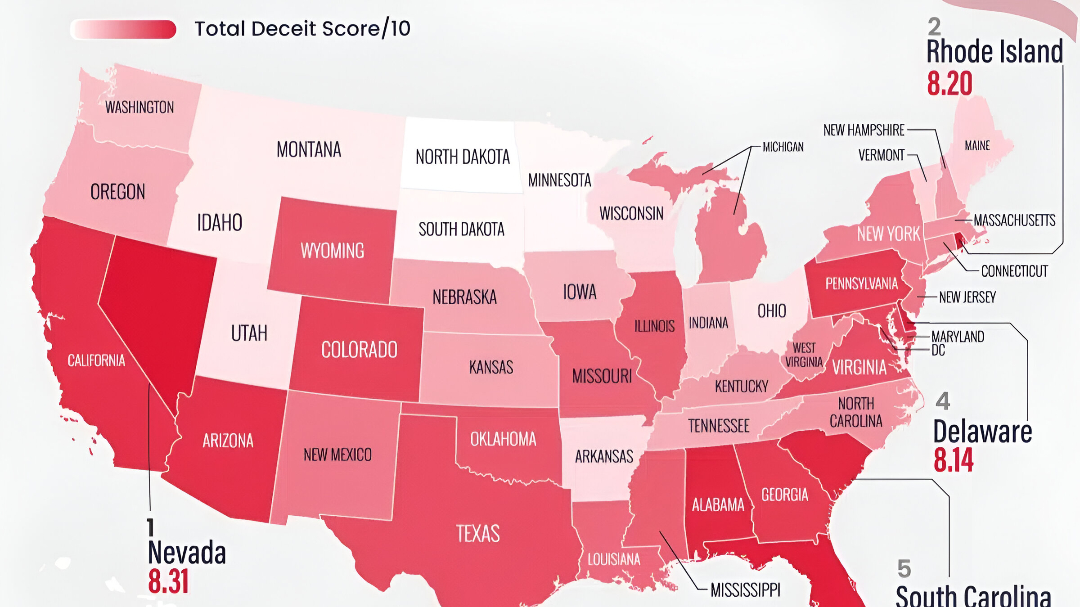
Nevada claims the dubious honor of America’s most deceitful state, with nearly one in five residents admitting they lie frequently and the state filing almost 60,000 fraud reports annually. Rhode Island actually tops the self-confession charts with a staggering 40% of residents admitting regular dishonesty—nearly double the national average. Florida rounds out the podium of deception, leading the nation in identity theft cases while hemorrhaging over $92.5 million to romance scams in 2024.
The Honesty Belt vs. Deception Hotspots
A stark geographic divide emerges between coastal gambling states and the virtuous rural Midwest.
The data reveals a cultural chasm that would make a political strategist weep. Coastal and gambling states dominate the dishonesty rankings, while the rural Midwest emerges as America’s conscience. North Dakota stands as the nation’s moral beacon, with zero survey respondents admitting to frequent lying and romance scam losses under $2 million statewide.
The pattern suggests either that the Midwest genuinely breeds more honest citizens or that Midwesterners are simply too polite to admit their sins to researchers.
Romance Scams and Fraud Capitals
California leads absolute losses while Arizona claims the per-capita deception crown.
California leads absolute romance scam losses at $104.8 million, but Arizona takes the per-capita crown with residents losing $53.7 million to online heartbreakers. Miami earns the distinction of fraud capital, reporting 2,800 cases per 100,000 residents—a rate that makes the city’s reputation for creative financing seem almost quaint.
The city also ranked third nationally for residents faking illness and among the top winter destinations for Ashley Madison affairs, creating a trifecta of modern deception.
The Methodology Problem
Regional differences in admitting wrongdoing may skew the honesty rankings more than actual behavior.
Here’s where things get interesting: researchers acknowledge a crucial flaw in measuring dishonesty. The gap between “deceitful” and “honest” states may reflect regional differences in admitting wrongdoing rather than actual behavior patterns. Midwestern humility might suppress confession rates, while coastal candor inflates them.
It’s the social science equivalent of asking people to rate their own driving—the results tell you more about self-awareness than skill. The romance scam trend offers a silver lining, with reports declining 9% in 2024’s first three quarters compared to 2023. But before celebrating human nature’s improvement, consider that fraud prevention education and victim awareness campaigns might simply be working.