

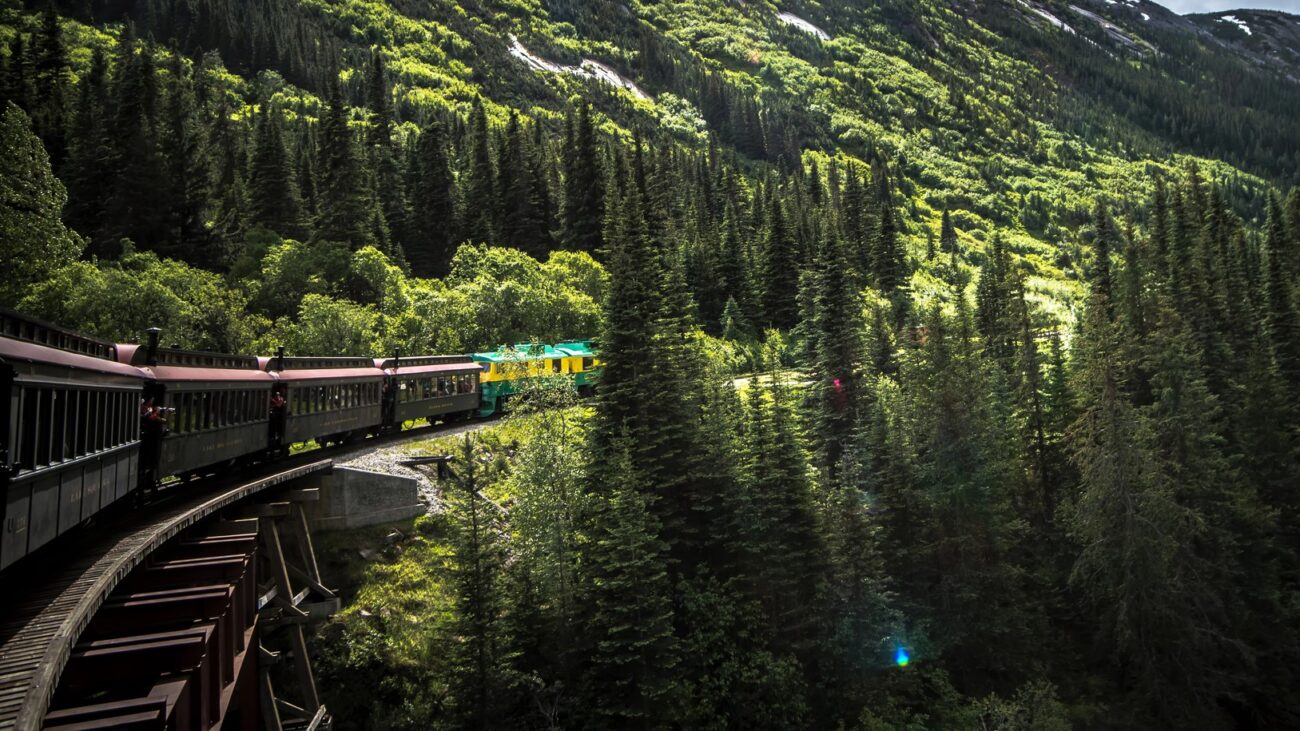
Most scenic train rankings rely on editorial intuition. This one used eye-tracking software. Travel insurance company InsureandGo ran a study measuring how quickly images from 24 global rail routes captured attention — and how long they held it. The White Pass & Yukon Route, a narrow-gauge railroad departing Skagway, Alaska, scored 76.9 out of 100, landing it among the top 15 most visually captivating train journeys on the planet. This railroad was built in 1898 to haul Klondike Gold Rush stampeders over the Coast Mountains, and it remains one of the most dramatic scenic corridors in North America.
What the Track Actually Shows You
From coastal forest to sheer cliff face, the scenery escalates quickly — and a canyon named for the horses that didn’t make it says everything about what this terrain once cost.
The train departs Skagway at sea level, easing through dense coastal forest before the terrain turns serious — fast. The track narrows against sheer rock faces, crossing sky-high trestles with deep canyon drops below. Bridal Veil Falls, a roughly 300-foot cascade, appears close enough to feel the mist. Then comes Dead Horse Gulch, named for the pack animals that perished on these slopes during the Gold Rush — the name alone conveys what this terrain once demanded of those who crossed it.
Sit on the left side of the car heading uphill. You’ll thank yourself when Skagway’s harbor opens below like a panorama you weren’t quite prepared for.
What passengers see during the 2.5–3 hour round-trip to White Pass summit:
- Bridal Veil Falls, a roughly 300-foot waterfall dropping near the tracks
- Dead Horse Gulch, a canyon marking one of the Gold Rush’s harshest passages
- Sheer rock faces, mountain tunnels, and narrow ledges blasted from solid cliff
- Wide harbor panoramas back over Skagway and the Inside Passage
- Vintage railcars with large picture windows and live narration throughout
Built for Gold, Running for History
Construction began May 27, 1898, and the railroad that outlasted the Gold Rush still moves passengers through the same cliffs that once defeated wagon roads and pack trails.
Workers broke ground at the height of the Klondike stampede, blasting a 3-foot narrow-gauge track into terrain that had already defeated wagon roads. The design wasn’t quaint — it was engineering logic: tighter curves, cheaper construction, and the ability to navigate terrain that standard gauge couldn’t touch. The railroad effectively replaced the punishing overland trails over White Pass and Chilkoot Pass, transforming a grueling crossing into a viable passage.
Today it runs May through September as a heritage tourist line, bookable directly through the WP&YR website or as a cruise shore excursion through lines like Holland America. Extended Yukon Expedition trips run approximately 8.5 hours for travelers with more time and stamina.
This is 127-year-old infrastructure still doing its job: moving people through one of North America’s most rugged landscapes, along the same cliffs where the Gold Rush tested the limits of human endurance and engineering ambition. That kind of reputation tends to be earned, not assigned.