


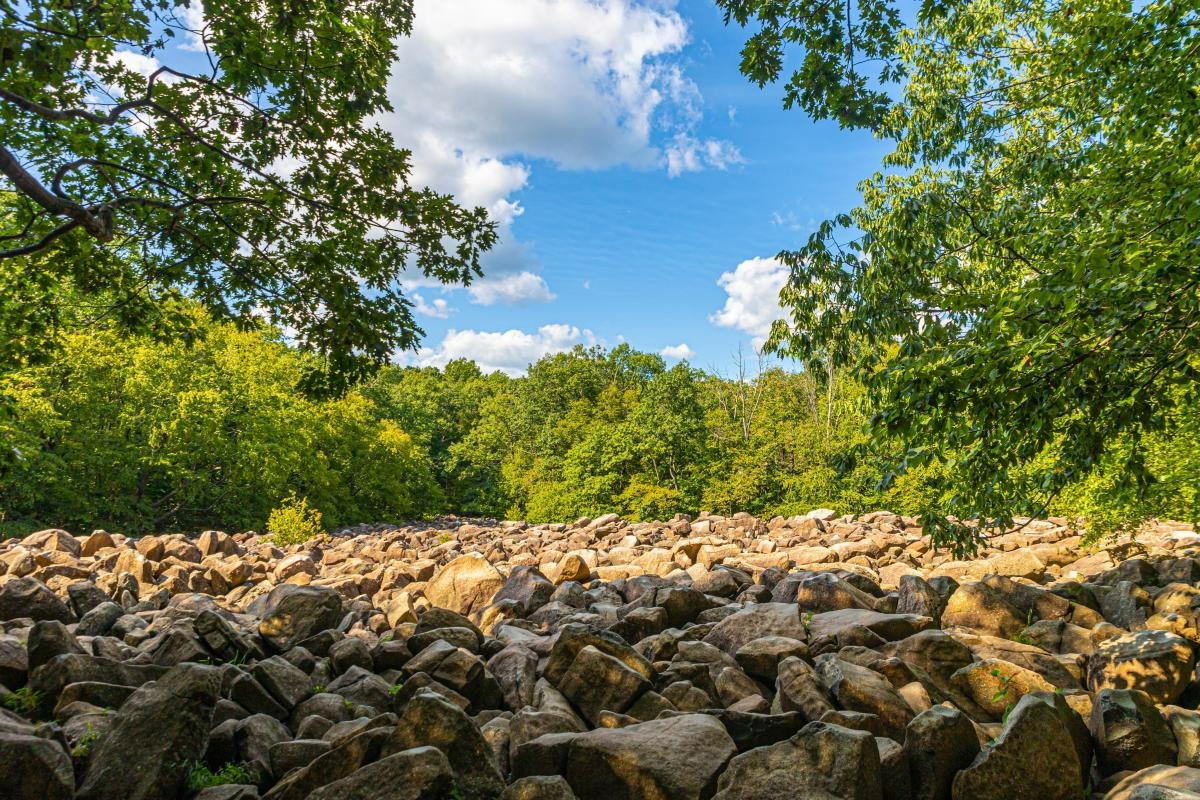
The metallic ping echoes across the barren landscape like a bell tower gone rogue. A family of five spreads across the boulder field, each armed with a hammer, testing rocks with the focus of a treasure hunt. Some stones respond with crystalline chimes. Others deliver satisfying gongs. Most stay stubbornly silent, producing the dull thud of ordinary rock meeting metal.
Welcome to Ringing Rocks County Park, where Pennsylvania hides one of its strangest geological mysterious places—a seven-acre field of boulders that literally sing when you strike them.
Ancient Forces Created This Natural Instrument
Two hundred million years of geological drama produced these musical stones.
The boulder field emerged from diabase rock formed during the Jurassic period, when magma pushed into sediment layers and hardened into dense, iron-rich stone. Glacial freeze-thaw cycles later fractured the bedrock into angular blocks and stripped away soil, creating this stark “sea of rocks” surrounded by typical Pennsylvania forest.
Scientists still debate why only some boulders ring audibly. The leading theory suggests all rocks technically vibrate when struck, but most produce frequencies below human hearing. The “live” rocks—those with internal stresses preserved through slower weathering—resonate within our audible range. Remove a ringing rock from the field, local lore claims, and it falls permanently silent.
Key Visitor Tips:
- Bring your own hammer—the park actively encourages rock-tapping
- Wear sturdy boots with good grip; boulder hopping demands balance
- Secure phones and keys to prevent losing them between rocks
- Pack bug spray during warmer months
- Allow 2-3 hours for the full experience including High Falls
From Forest Path to Lunar Landscape in Minutes
The contrast hits immediately—verdant woods opening onto barren stone.
The short trail from the parking lot winds through typical mixed hardwood forest before breaking suddenly into something resembling Mars with better acoustics. The visual shock amplifies the auditory surprise as your first tentative hammer taps reveal which stones joined nature’s percussion section.
Visitors often spend an hour mapping the field’s tonal landscape, testing dozens of rocks to find their favorites. Children delight in discovering they can pick out simple melodies once they identify stones with complementary pitches.
The quest for the perfect ring becomes addictive. Rocks near the field’s center tend to produce clearer tones, possibly because they’ve avoided soil contact that might dampen their resonance.
A 15-minute hike beyond the boulder field leads to High Falls, considered the largest waterfall near Philadelphia, though it flows best after heavy rains.
Park facilities stay deliberately minimal—portable toilets, picnic tables, and that crucial small parking lot tucked behind easily-missed signage on country roads in Upper Black Eddy. This geological oddity operates like nature’s own escape room: bring curiosity, patience, and protective footwear.
The park opens daily from dawn to dusk with no admission fee, making it perfect for pairing with Bucks County’s farm markets and river town cafes.